Parsifal at Deutsche Oper Berlin
A curtain opening onto a cross, living tableaus, and an evening so unexpectedly moving it has stayed with me ever since.
🎭 Parsifal
🎶 Richard Wagner, 1882
💭 Philipp Stölzl, 2012
🏛️ Deutsche Oper Berlin
🗓️ 03.04.2026
Continuing our retrospective of productions that I watched weeks, if not months, ago, but that have occupied a space in my mind since. Parsifal happened on Good Friday, April 3rd, and I've been meaning to write about it ever since; partly because it was, unexpectedly, one of the most moving evenings I've had in a theatre in recent memory, and partly because the questions it raised haven't quite settled.
"WEISST DU DENN NICHT, WELCH' HEIL'GER TAG HEUT' IST?"
I am not a devout person. I grew up in a part of the world where Christianity is so thoroughly part of our social fabric—in the school calendar, the street names, the rhythm of public life—that you absorb its stories and its imagery almost without noticing, the way you absorb a language you were never formally taught. I wouldn't have said that made me susceptible to a five-hour Wagnerian sacred drama about the Knights Templar and the Holy Grail.
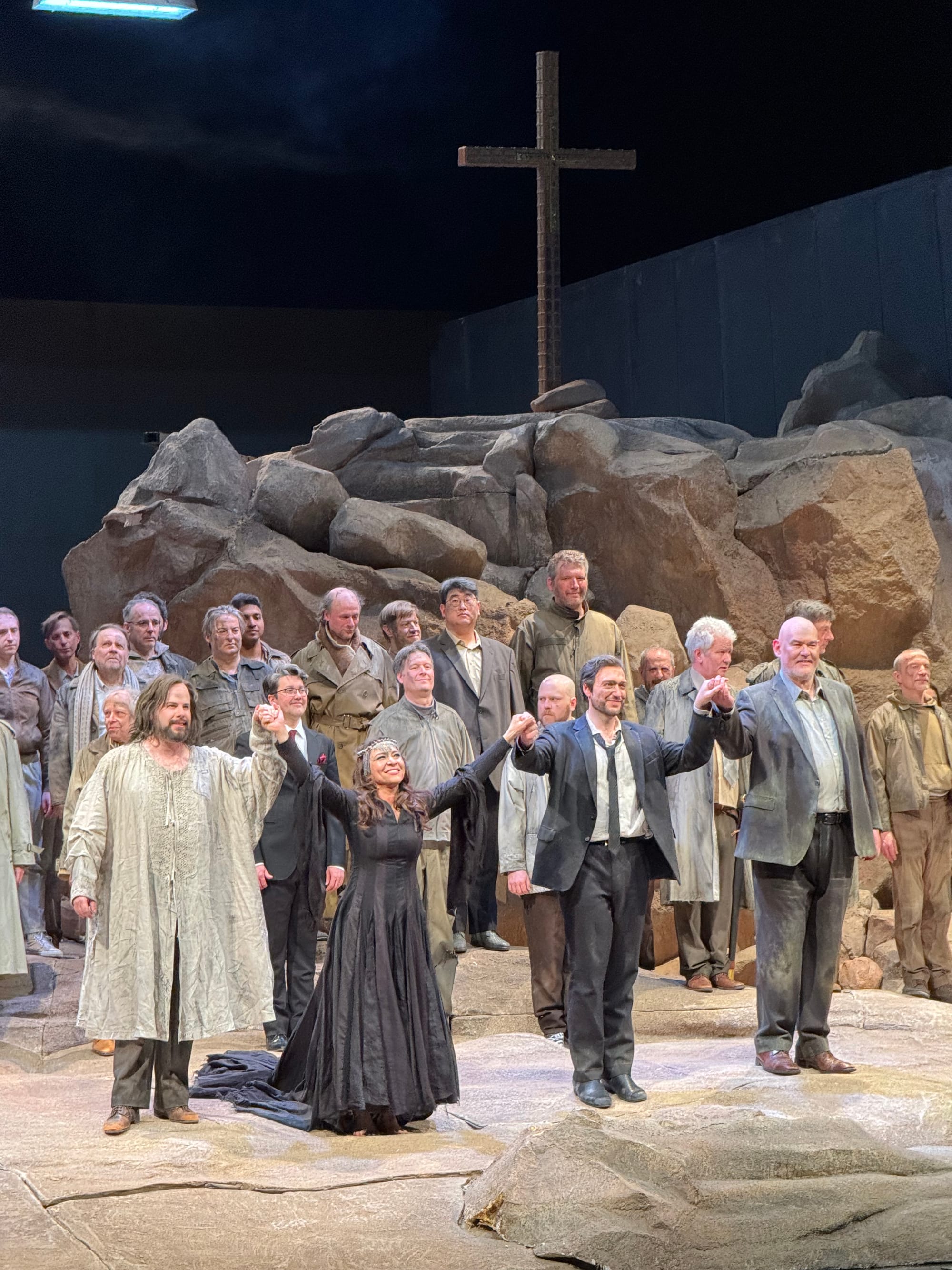
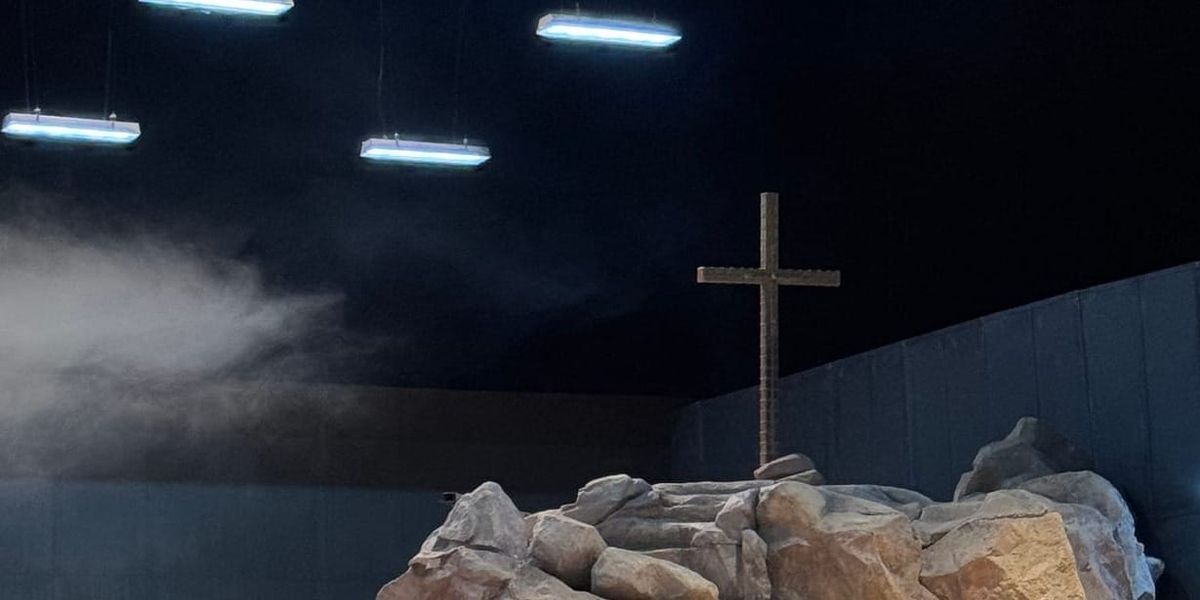
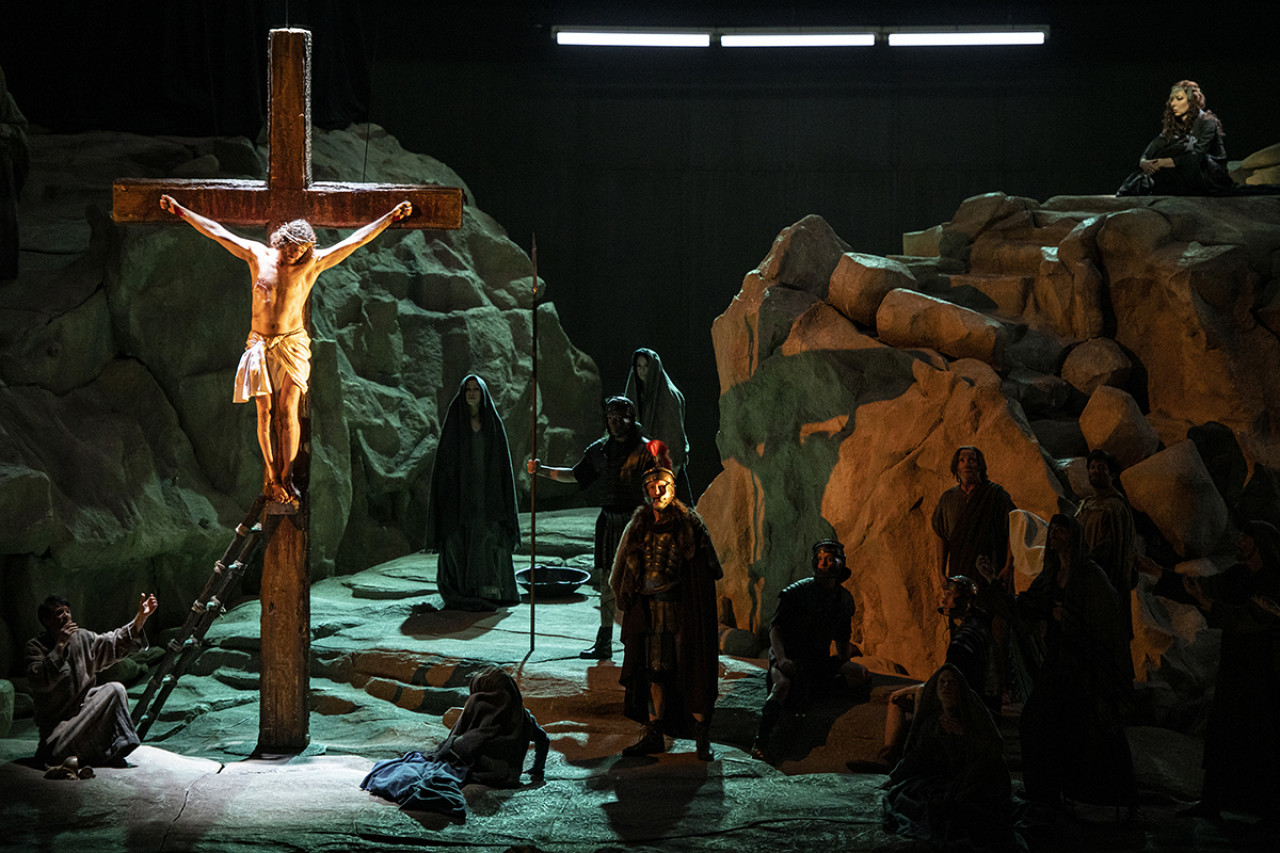
And then the curtain opened: a man on a cross, lit from the surrounding dark, soldiers and mourners arranged at his feet, the wound in his side freshly pierced. And from the edge of the stage, a woman laughing. The music had already done something to me by then; the prelude to Parsifal being one of those pieces of music that earns the word transcendent by simply leaving no space for resistance. By the time the tableau vivant resolved into something I could read and react to, I was already further gone than I'd anticipated.
I saw this production on Good Friday, which was not an accident.
The Church's Oldest Technology
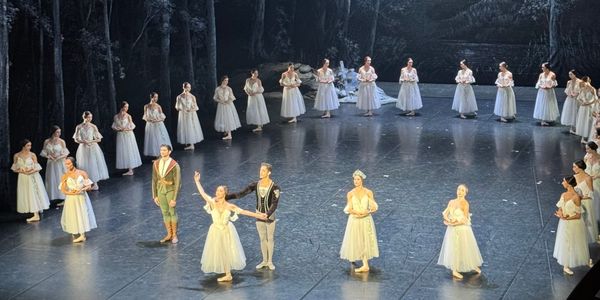
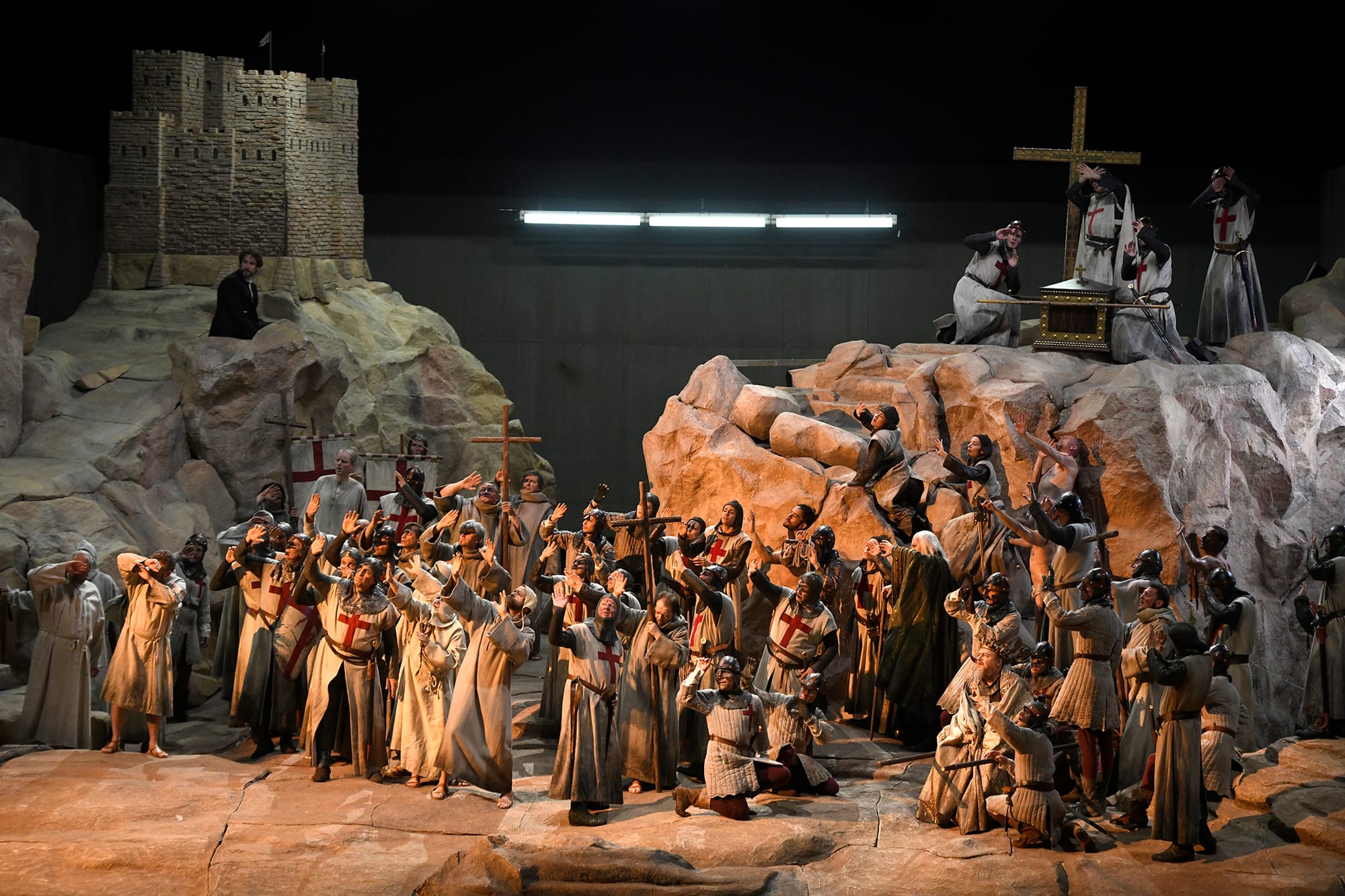
This production at Deutsche Oper Berlin structures (or rather in past tense, structured—this was the second to last show of the Stölzl staging) its storytelling around such tableaux vivants: the stage freezes into a living image whenever the backstory needs telling, the singers holding position while the spotlights shift and the scene becomes something between a diorama and an altarpiece. It is, as a device, almost aggressively on the nose. But the more I sat with it, the more I came to feel that on the nose is precisely the point—that the production is reaching for something old and deliberate rather than naive.
Walk into almost any European cathedral built in the last five centuries and you are surrounded by images that tell this same kind of story. The Stations of the Cross. The Nativity. The Pietà, the Annunciation, the Last Supper rendered on walls and ceilings, on canvas and stone. For centuries before widespread literacy, before mass printing, before the sermon became the primary mechanism of religious instruction, visual narrative was how the church kept its mythology alive—how it pressed meaning into the people who moved through its spaces. The tableau vivant as a theatrical form is a direct descendant of this tradition: the story made flesh, held still, made legible.
Parsifal is not, of course, canonical. Kundry doesn't exist in the Bible; neither does Parsifal; the Holy Grail as Wagner imagined it is a composite mythology, part Arthurian legend, part Christian symbolism, part his own elaborate invention. But Wagner is doing with Christian mythology something analogous to what he did with Norse mythology and Germanic epics in the Ring Cycle: borrowing its scaffolding, its imagery, its emotional grammar, and building something new inside it. The living tableaus here—the crucifixion, the spear being taken, the wound being inflicted—have the same function as the altarpieces they echo: to make the abstraction visible, to give the listener's eye something to hold while the music does its deeper work.
That it sometimes feels theatrical in a way those altarpieces did not is beside the point, or perhaps it is the point. We are not medieval parishioners. We know we are watching. And the production, I think, knows that we know.
Kundry, Fixed in Time
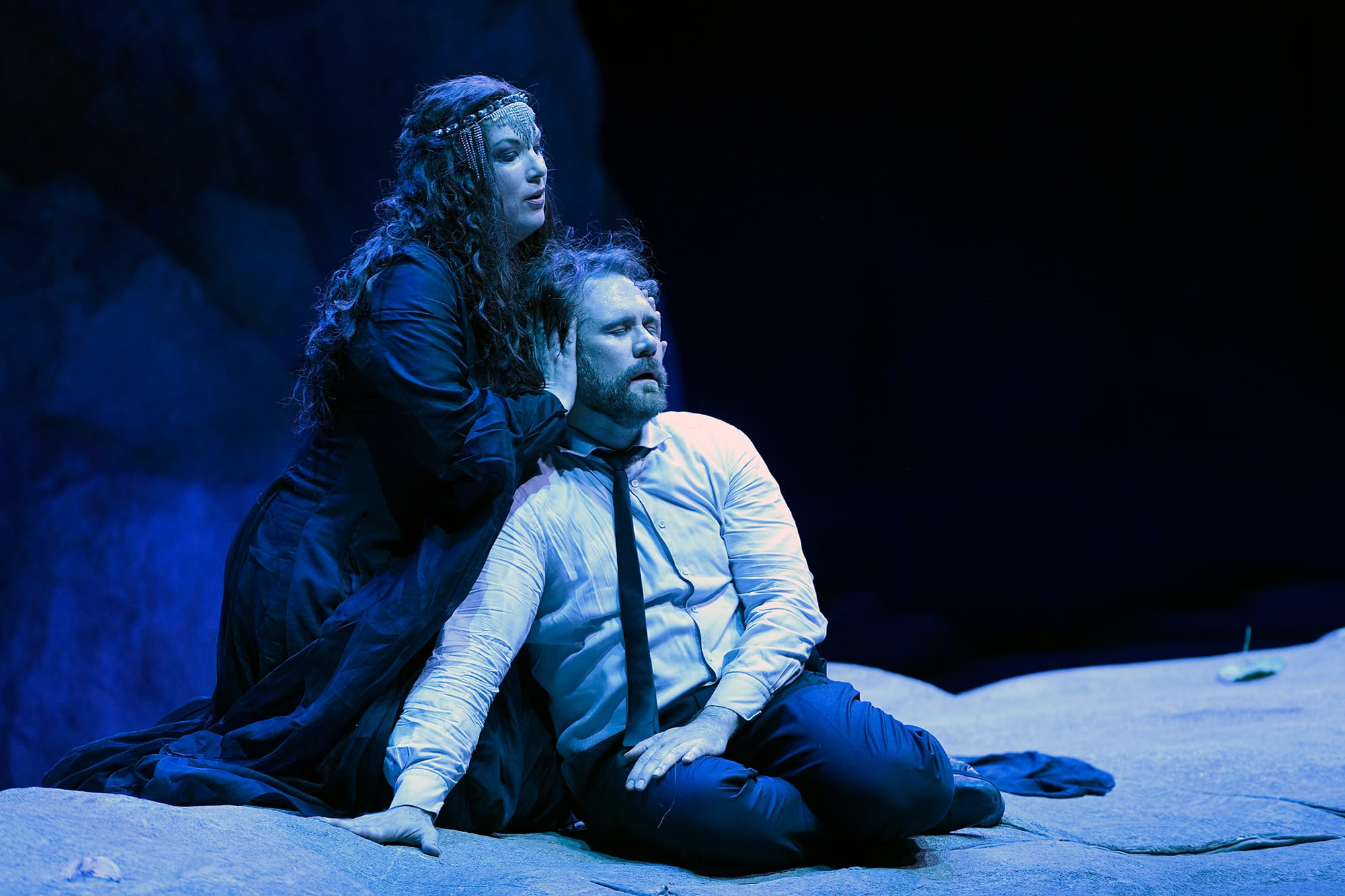
What this staging does quite compellingly—what has stayed with me most in the month since I saw it—is its decision to center Kundry rather than Parsifal.
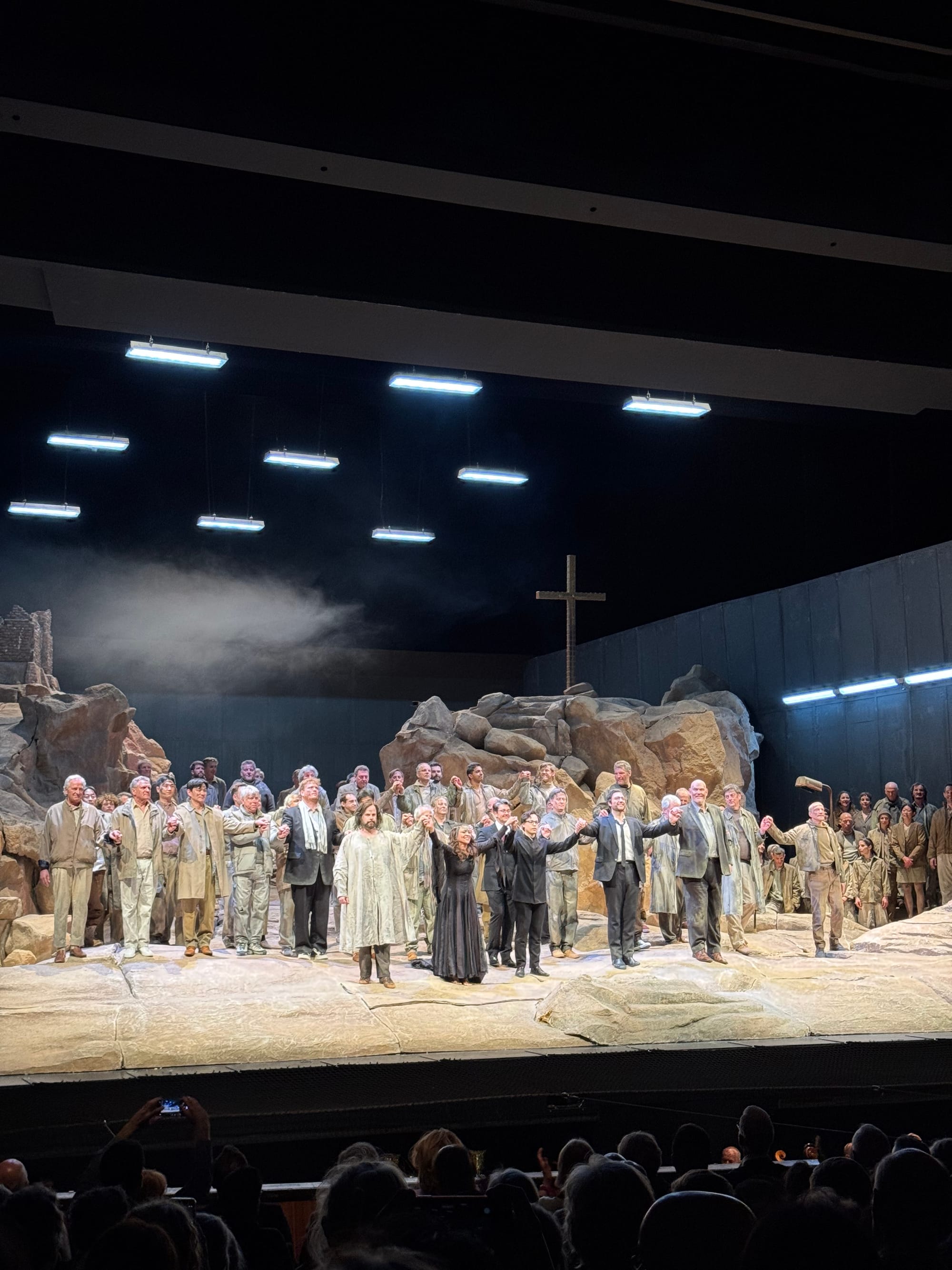
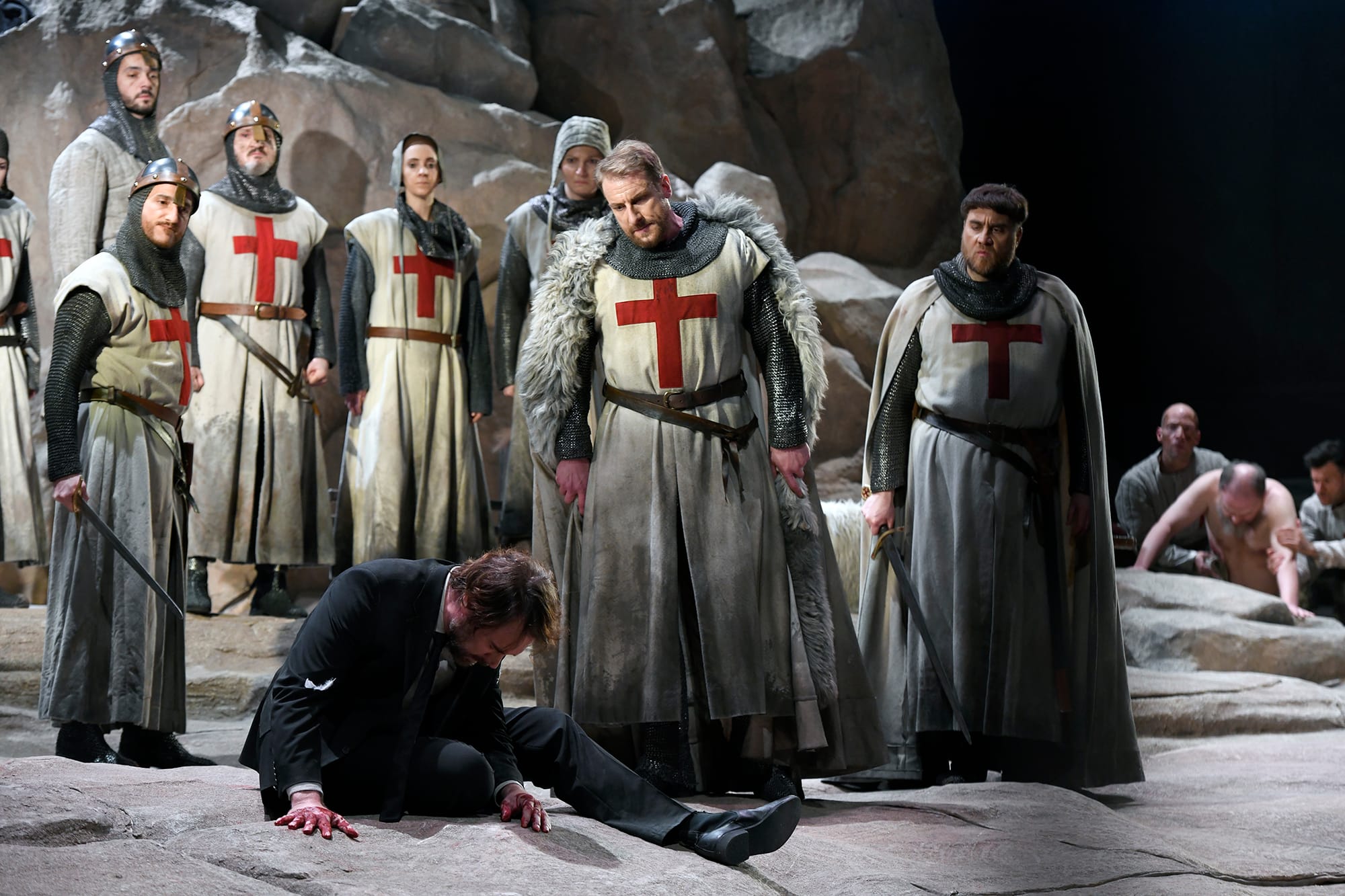
The logic of this becomes clear early and deepens across the evening. Every other character's costume shifts across the opera's three acts, marking the passage of time, the decay of the Grail order, the movement from medieval certainty into something more contemporary and rundown. Parsifal enters in a suit with a briefcase—a Japanese salaryman walking into a Crusade—and the Knights Templar migrate from medieval garb through to something post-industrial and worn by Act Three, as though the production spans not a single narrative arc but centuries of historical drift. The set in the final act reads like an archaeological excavation of the first: the same landscape, but the castle in ruin, the lighting stark and scientific, everything held at the clinical distance of a field study.
Kundry alone moves through none of this. Her black gown is the same in Act One as in Act Three. She is the fixed point around which the story turns—not redeemed, not transformed, not given the developmental arc that the opera's surface narrative would seem to promise her. She simply persists. And there is something almost unbearable in that: to be the one for whom time is not a release, to carry the curse across every historical era the production moves through, to still be recognizably yourself when everyone else has been remade.
What the production does with her laughter is more ambiguous. Kundry's curse originates in a laugh—she laughed at Christ on the cross, and that act of derision set the machinery of her suffering in motion. This is, as the opera insists, her Ursünde, her original sin, which casts her almost as a second Eve: the woman whose transgression underwrites the whole subsequent story. In a late moment of the production, as Parsifal is acclaimed and Amfortas is deposed, she laughs again—at Amfortas in his despair, the same gesture repeating across two thousand years of narrative—and the production holds the ambiguity rather than resolving it. Is this her nature, inescapable? Is it compulsion? Is it resistance? I don't know, and I suspect the production doesn't want me to. The program notes deal extensively with reliquaries in Catholicism—the idea that what remains of a sacred body holds its power, circulates, becomes the target of devotion—and Kundry feels like this production's relic: the thing that persists when everything else has decayed, still charged with whatever it was she carried at the beginning.
Act Two and Its Issues
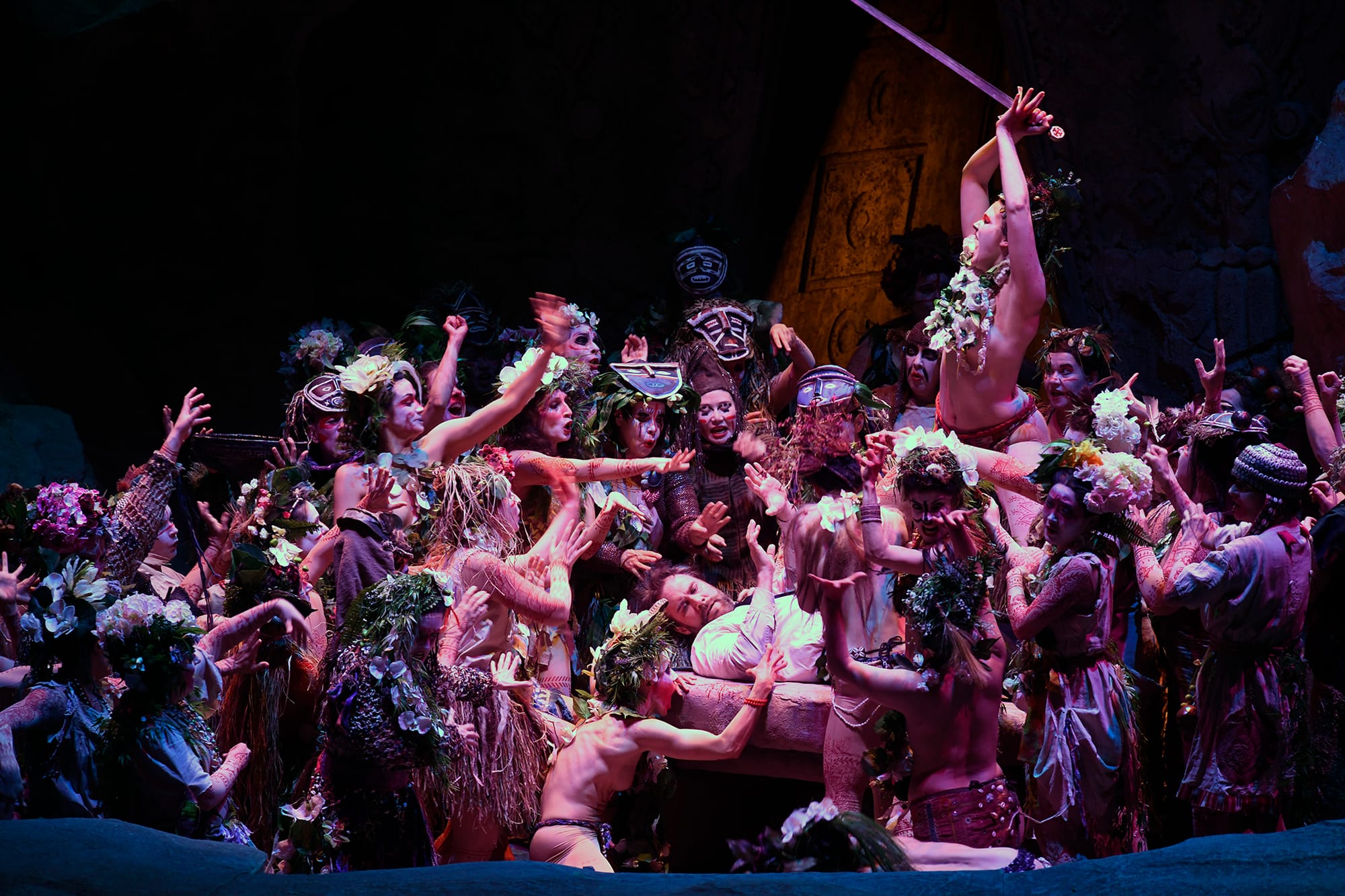
The production's most unresolved section is Act Two, and I say that while acknowledging that Act Two of Parsifal is a problem almost any director has to manage: Klingsor's realm, the flower maidens, the seduction scene, the spear—it's the opera's most dramatically schematic material, and it has a way of exposing the limitations of whatever visual language a production has chosen.
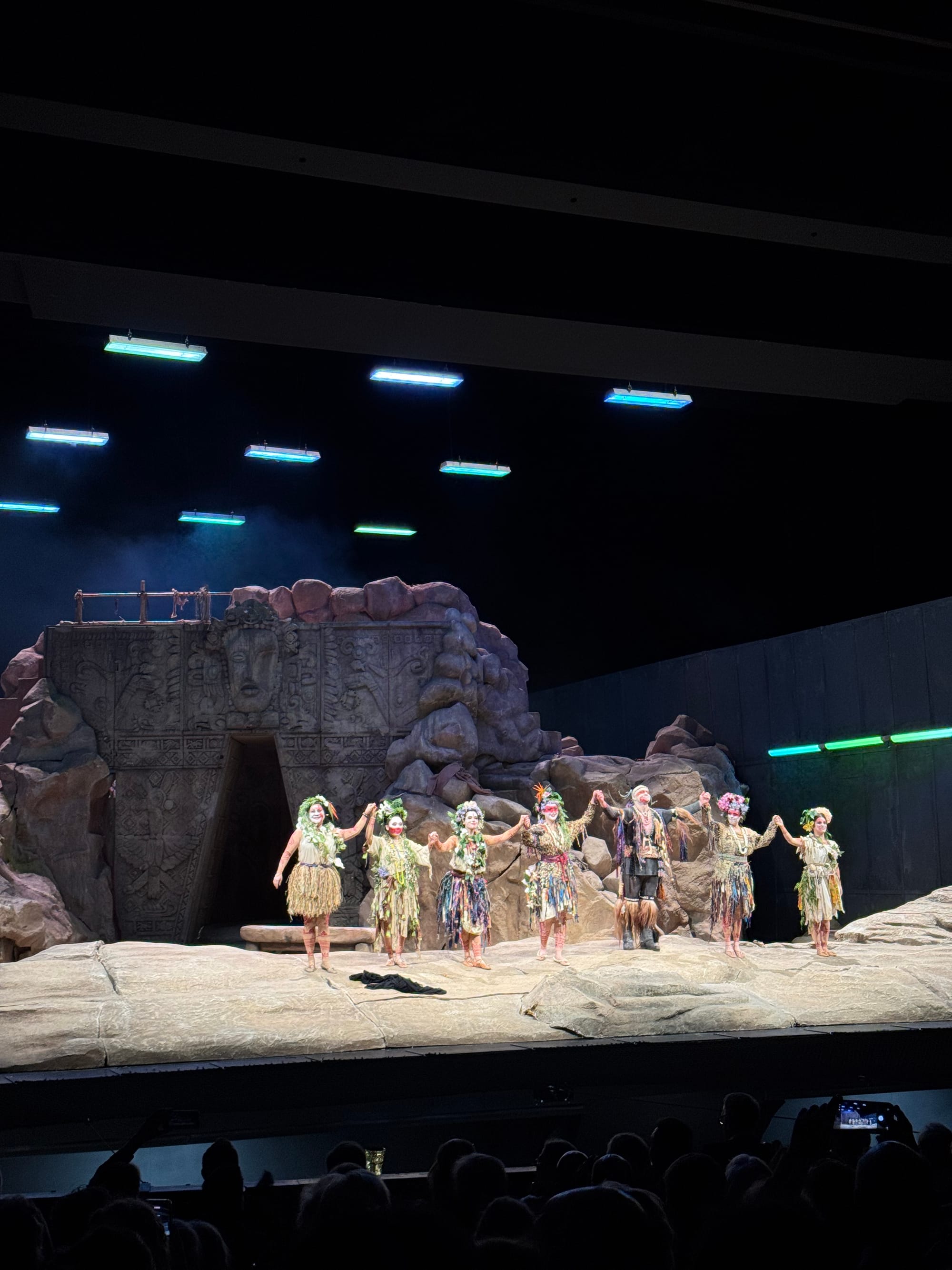
Here, that visual language tips into something I didn't quite know how to read. The aesthetic for Klingsor's domain is Mesoamerican: stone surfaces worked to suggest Mayan or Aztec temple architecture, a sacrificial altar, costumes that gesture toward pre-Columbian ritual, a heart removed from a body and offered up. There is a logic in reaching for a non-European iconography of the sacred—Klingsor is, after all, the opera's designated outsider, the one expelled from the Grail order, the counter-image to its Christian symbolism. And there's a superficial coherence in setting his domain in a visual vocabulary from outside that tradition.
But something in the execution felt uncomfortably like a 20th-century adventure film's division of the world into civilization and barbarian: the orderly, suffering Knights Templar on one side; the exoticized, sacrificial, indigenous Other on the other. I may be bringing assumptions to this that the production doesn't fully warrant. The stagings really are striking; the visual contrast is legible and dramatically useful. But that particular unease didn't entirely leave me.
Act Three and the Music
The third act places us more firmly in the present—or at least in something recognizable as contemporary: stark lighting, figures in lab coats moving through the ruins of the Act One landscape, the whole scene carrying the atmosphere of an archaeological dig or a research site where something has long since ceased to function. There is something of Westworld in this, the franchise's premise of an artificial paradise in disrepair, characters stuck in elaborate and eternal narrative loops.
It is also where the music does its most devastating work. The Karfreitagszauber—the Good Friday spell, the moment of renewal and anointing that arrives in the final act—is one of the most quietly transformative passages Wagner ever wrote, and this performance made it felt. The moment of Parsifal's baptism, the washing of the feet, the almost unbearably gentle quality of what the orchestra does beneath it: I had full-body chills, which is not a response I have often to something I've intellectually anticipated. The acapella choir that accompanies the Grail revelation in Act One had done something similar: a sound that arrived sideways, that the body registered before the mind had finished processing it.
The production's ending mirrors its beginning. Amfortas—deposed now, diminished—enters carrying the cross, wearing the wound that the opera has consistently aligned with Christ's own: the spear-wound in the side, the same gesture repeated across two thousand years of symbolic time. Kundry brings him water. When he falls, she laughs. And then Titurel's glass casket is broken open, and Amfortas cradles his father's body there, in the ruins of the order he failed to sustain, and the evening closes not with resolution but with the image of a man holding what remains.
A Thousand Years
Somewhere in the second half—I want to say it was after the sinners had processed across the stage in their penitential parade, flogging themselves and fighting what looked like an invisible force rising from the orchestra pit—I found myself doing the math that this opera almost inevitably occasions.
We are sitting here roughly a thousand years after the Crusades. The Crusaders themselves existed roughly a thousand years after the crucifixion that this opera is, in some displaced and mythologized sense, about. Wagner wrote Parsifal in the middle of that second millennium, in 1882, and it is still being staged, still filling opera houses, still—on Good Friday, in a darkened theatre, with a prelude that gets there before your defenses do—making people feel something they weren't prepared for.
The question that occurred to me, and that I haven't been able to put down, is perhaps an obvious one: what does this story look like in another thousand years? How do you stage Parsifal in 3026, when our current two-thousand-year span of Christianity is itself a historical artifact, when the symbolism of the cross and the spear and the Grail has either calcified into pure abstraction or found some new form of life we can't imagine from here? I don't know. Nobody does. But that this is even a question worth asking—that a story rooted in a crucifixion two millennia ago can still produce that question, still feel like it has a future as well as a past—is itself something.
I grew up in a tradition shaped by this story without ever really connecting to it; I watched it performed on the day its tradition uses to commemorate a death; I came out of the theatre thinking about time in a way I usually don't. Two months later, I'm still thinking about it. Now that's the power of opera!

Cast
Musical Direction Tarmo Peltokoski
Director Philipp Stölzl
Co-Director Mara Kurotschka
Staging Conrad Moritz Reinhardt, Philipp Stölzl
Costumes Kathi Maurer
Light Ulrich Niepel
Choirs Jeremy Bines
Children's Choir Christian Lindhorst
Amfortas Thomas Lehman
Titurel Tobias Kehrer
Gurnemanz Albert Pesendorfer
Parsifal Attilio Glaser
Klingsor Lawson Anderson
Kundry Irene Roberts
1. Gralsritter Burkhard Ulrich
2. Gralsritter Benjamin Dickerson
1. Knappe Meechot Marrero
2. Knappe Arianna Manganello
3. Knappe Sunnyboy Dladla
4. Knappe Michael Dimovski
Blumenmädchen (1. Gruppe) Hulkar Sabirova
Blumenmädchen (1. Gruppe) Lucy Baker
Blumenmädchen (1. Gruppe) Arianna Manganello
Blumenmädchen (2. Gruppe) Hye-Young Moon
Blumenmädchen (2. Gruppe) Meechot Marrero
Blumenmädchen (2. Gruppe) Stephanie Wake-Edwards
Stimme aus der Höhe Stephanie Wake-Edwards
Choirs Chor der Deutschen Oper Berlin
Choirs Kinderchor der Deutschen Oper Berlin
Orchestra Orchester der Deutschen Oper Berlin
Dance Opernballett der Deutschen Oper Berlin