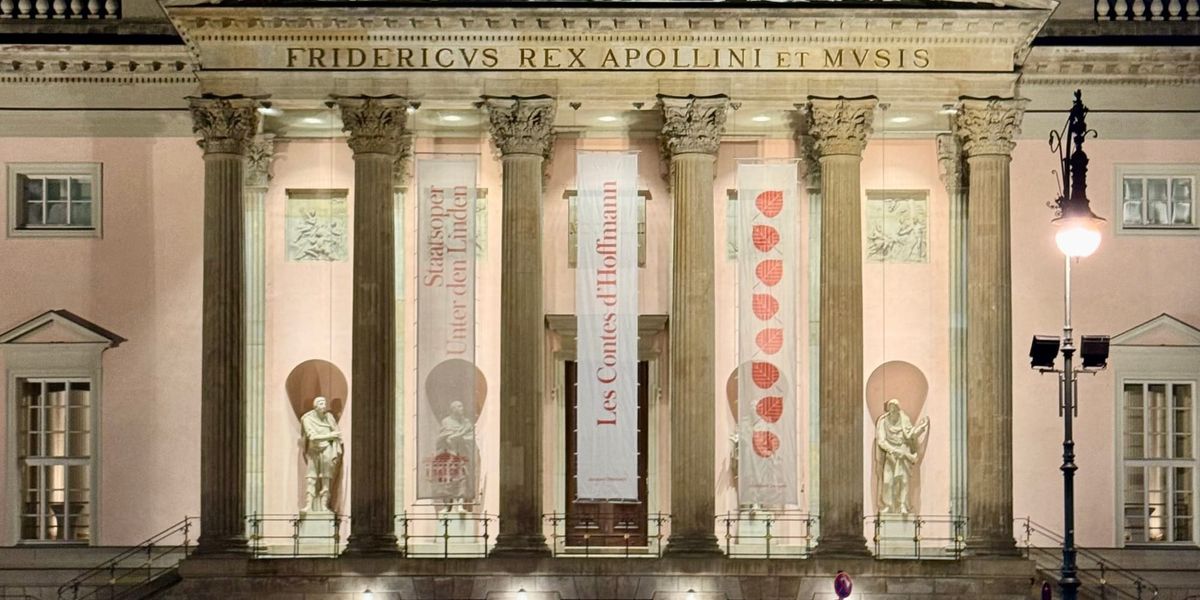
Les Contes d'Hoffmann at Staatsoper Berlin
A man collapses outside a peep show, and spends the rest of the evening learning why. On shame, desire, and the particular wreckage of a man who never healed his inner child.

🎭 Les Contes d’Hoffmann
🎶 Jaques Offenbach, 1891
💭 Lydia Steier, 2025
🏛️ Staatsoper Berlin
🗓️ 05.03.2026
"IF I MADE YOU SUFFER, IF YOU LOVE ME, FRIEND, FORGIVE ME"
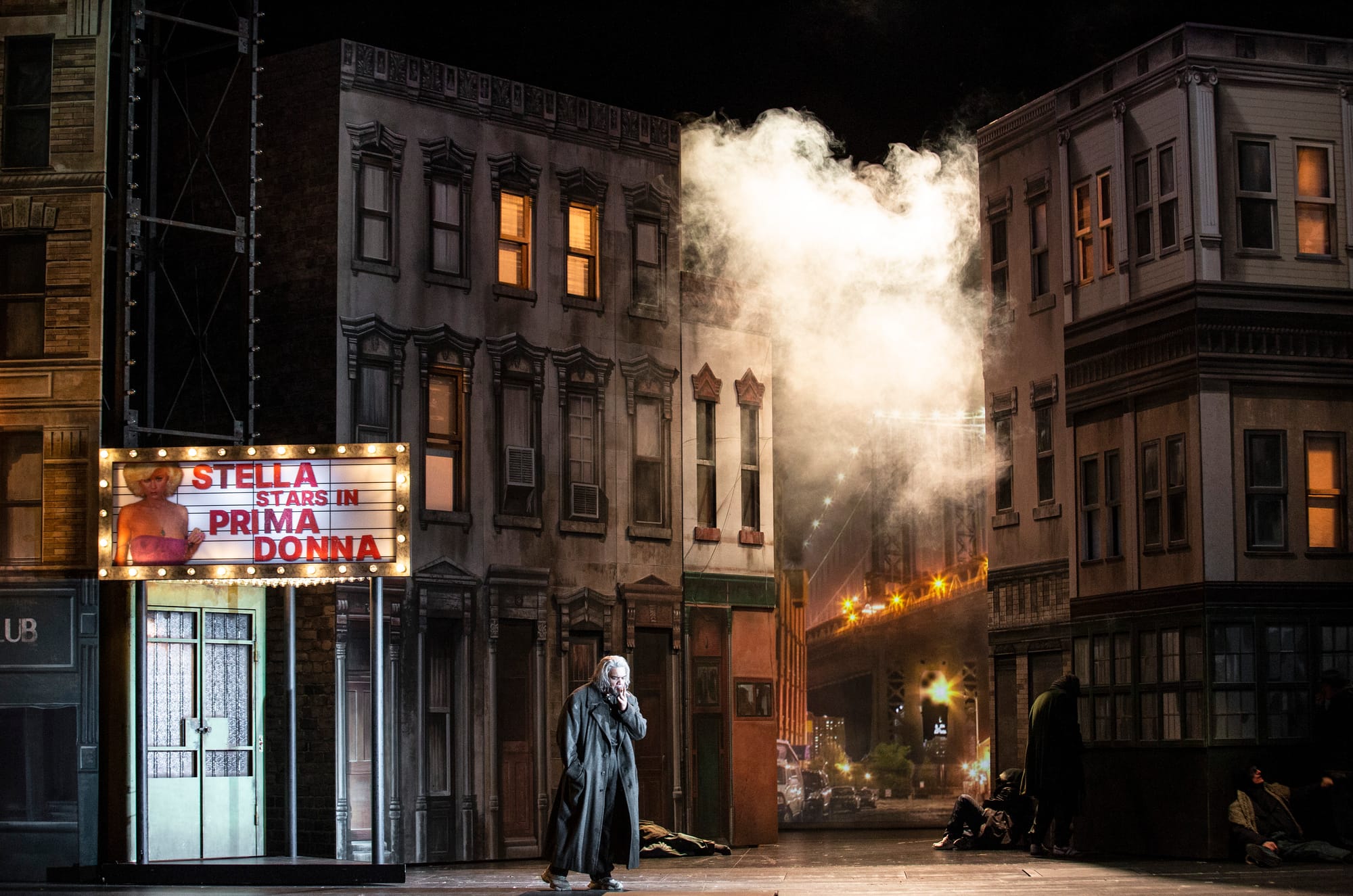
The curtain rises on a view so recognizable it borders on comedy: that New York City Instagram shot, the one that's been filtered and reposted into near-abstraction—brick buildings flanking an alleyway, the Brooklyn Bridge visible at the end of it, photogenic and hollow and immediately, precisely legible as a symbol of a life that peaked aesthetically somewhere around 2015. Hoffmann stumbles out of what might be a theater or a peep show, and collapses dead before anyone's had a chance to miss him. First responders arrive, and they confirm what the production has apparently decided from the outset: this man is already over, and everything that follows will be a kind of forensic accounting of how he got that way.
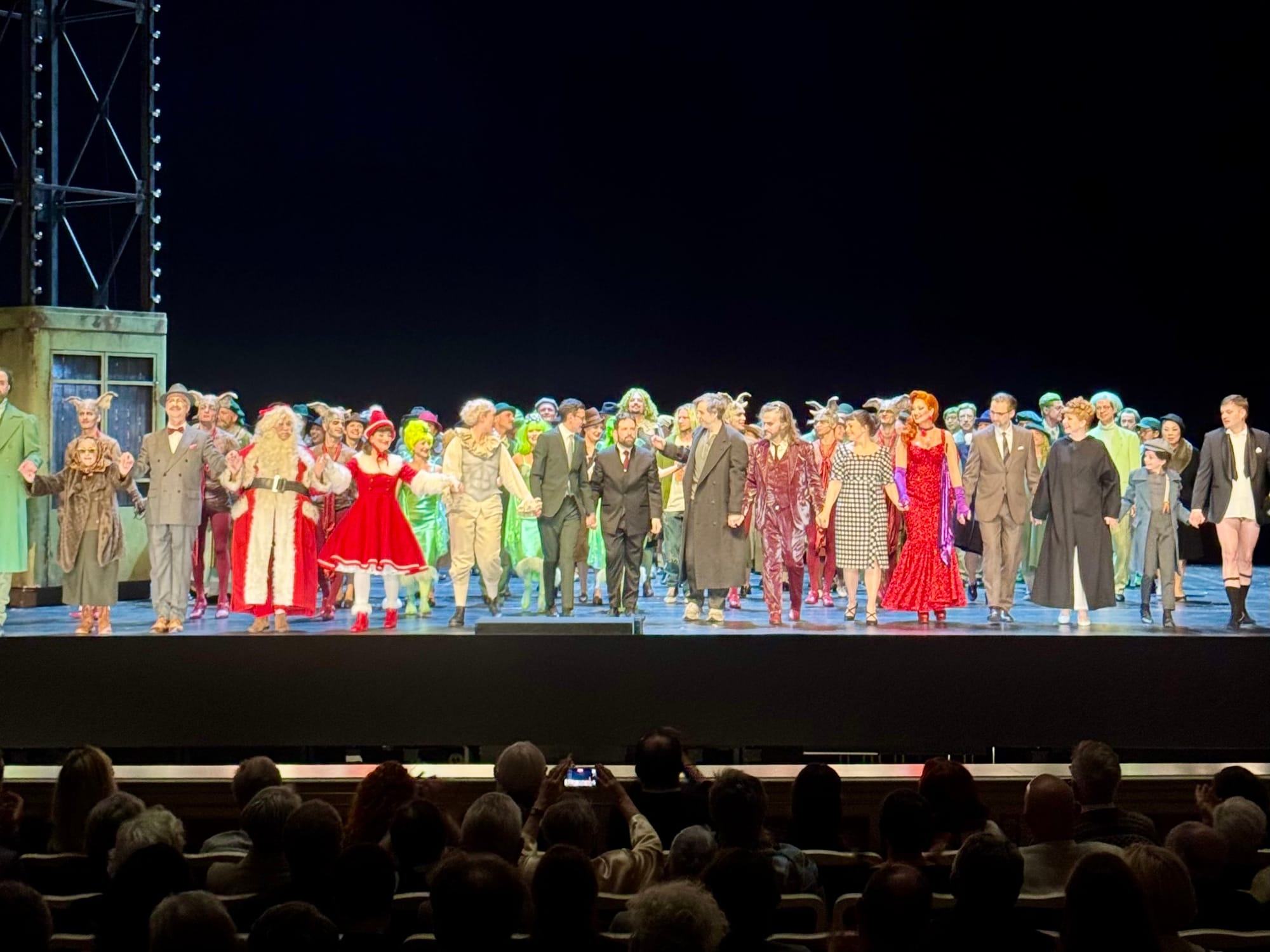
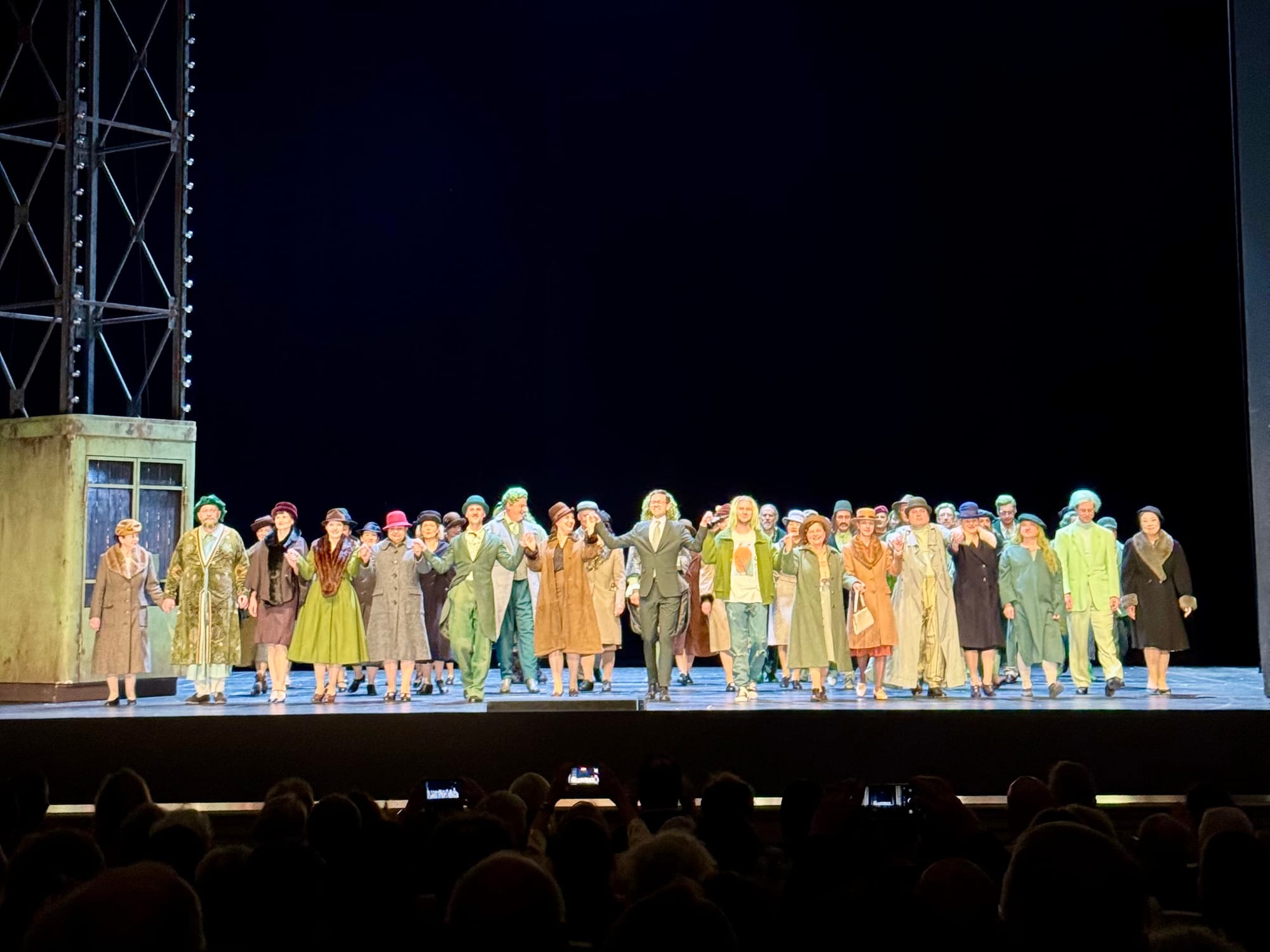
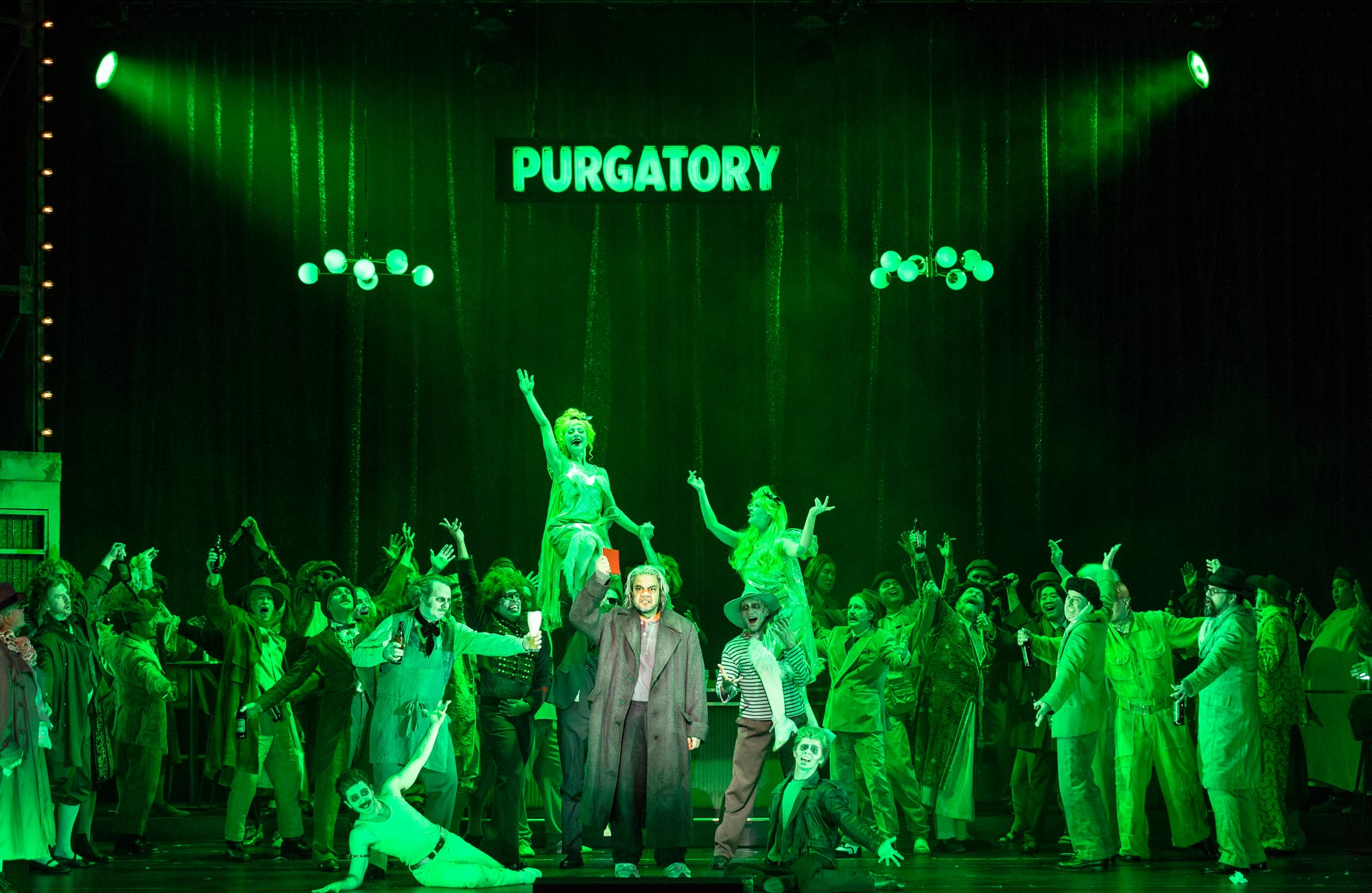
It's a brave structural gamble, killing your protagonist before the first aria, and Steier earns it by committing fully to what it implies: the opera reframed not as romantic tragedy but as purgatorial guided tour, a Dickensian visitation-of-the-past through which Hoffmann—escorted by angel and devil in the manner of a man who took the Scrooge extended cut—is walked back through the women in his life, each a distinct and differently shaped disaster. Purgatory itself is rendered in absinthe greens and 1920s art deco languor, populated by dead artists (Mozart, Elvis, the usual suspects of doomed genius) who apparently also failed to resolve their contradictions in time. It's a little on the nose, but the point lands: being both brilliant and a mess doesn't get you a pass, it just gets you company.
Benjamin Bernheim, who carries the role with the particular quality of someone watching himself from a slight distance—present in every scene, never quite inside it—makes this legible without making it pathetic, which is the tightrope the production walks for the entire evening.
A World Built Act by Act
Before getting to the women themselves, it's worth pausing on what Steier has built around them—because the production's visual ambition is, by any measure, considerable. This is not a staging that establishes a single aesthetic world and inhabits it for the evening; it's one that builds an entirely new one for each act, the purgatory bar ascending from below to anchor the piece's framing, the department store assembling itself for Olympia, each subsequent act arriving as its own dedicated visual proposition. The cumulative effect is of a production that has done an unusual amount of work—structural, spatial, imaginative—and it shows, in the best sense.
There's a loose temporal drift across the evening, too: Hoffmann's childhood reads as 1940s American, Antonia's world as something vaguely mid-century European, the brothel landing somewhere in the grittier end of the 1970s—though Hoffmann himself moves through all of it in trainers, unbothered by period consistency, which is either a deliberate statement about his status as a figure outside time or simply a choice, and either way it works. The production isn't trying to anchor itself to a single era; it's building separate worlds, and the craftsmanship across most of them is genuinely impressive.
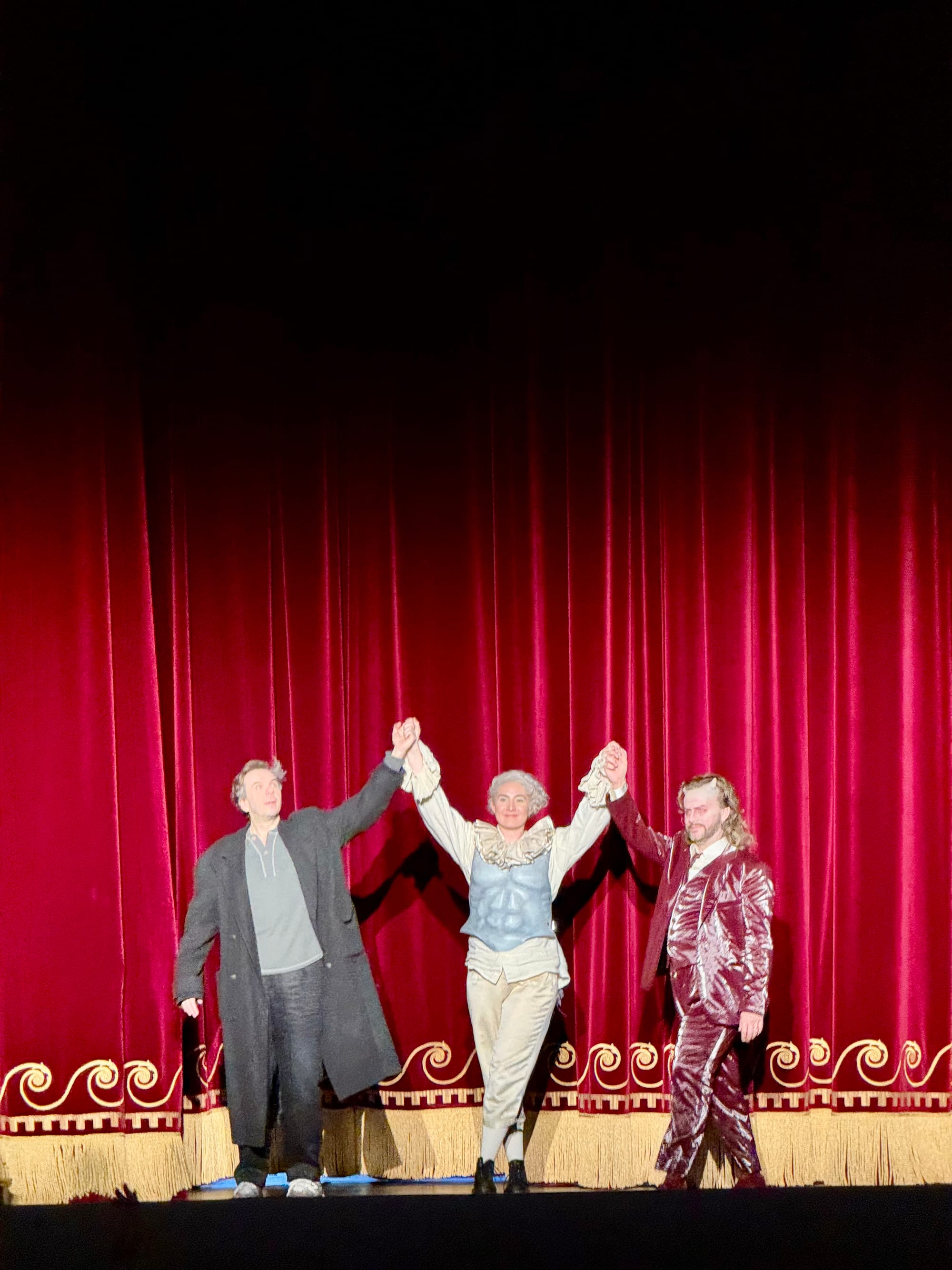
Most of them. Because alongside the high-quality work—and the costumes, which in the majority are beautifully made, the kind of thing you notice as craft—there are a handful of choices that look, by comparison, like afterthoughts. The angel, who is not a minor character but Hoffmann's guide through the entire evening, is saddled with a breastplate, a curly wig, and wings that read as noticeably cheap against everything surrounding them—the visual equivalent of a loose thread on an otherwise immaculate jacket. The waitresses in the purgatory opening, in their neon green outfits, have a similar quality: the materiality feels sloppy in a way the rest of the production doesn't permit itself to be. It's a minor complaint, in the scheme of things, but a real one—and it stings slightly more precisely because the surrounding work is so good.
The Doll, the Department Store, and the Wet Spot
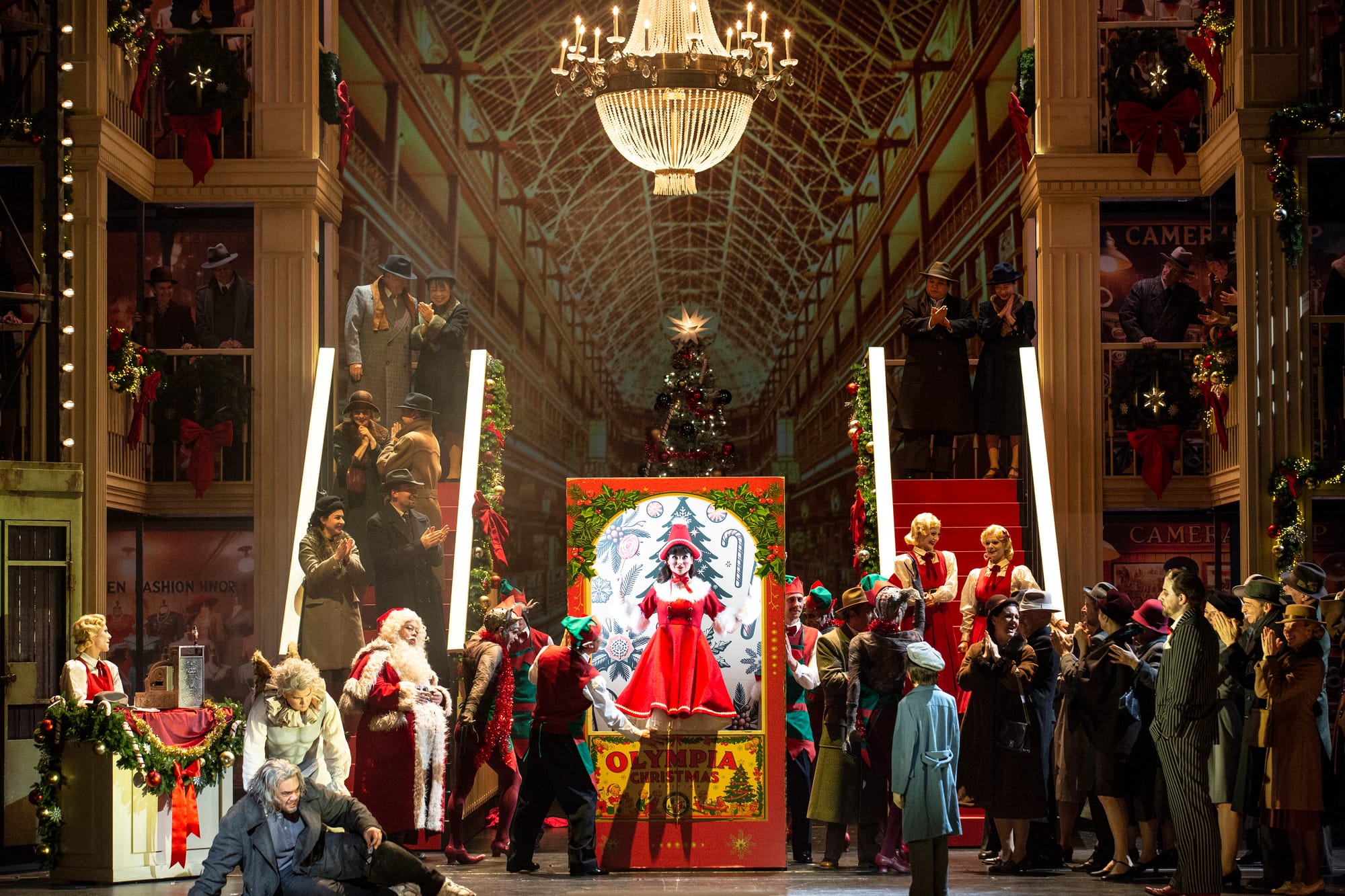
The Olympia act is where the production does its most interesting and most uncomfortable work, and, to describe it in my best vernacular, it left me gagged. Set in a 1940s department store, it dispenses with the mechanical life-sized automaton of the libretto almost entirely, giving us instead Hoffmann as a child, maybe nine or ten years old, falling in love with a doll in a glass cabinet. His mother forbids the purchase, initially for financial reasons rather than gendered ones (a small grace note), and the other girls in the store mock him for wanting it in the first place. Eventually, someone relents and buys an elated Hoffmann the doll. His wholesome playtime is interrupted by the other girls, who bully him and eventually sever the doll's head in a struggle for who gets to play with it. It is, as a sequence of events, both very operatic and extremely true to life.
What Steier does next is either very brave or slightly too much, and I suspect the honest answer is both: the life-size Olympia, who has been staged as a pull-string talking doll, is joined in her box by an eager Hoffmann who starts to fondle her and then disappears underneath her skirt. The box rotates away from the audience, starts shaking, and reveals a mannequin Olympia in pieces. What remains is a single mannequin leg, held by a visibly startled Hoffmann. As his mother drags him to the front of the stage and opens his coat to reveal stained trousers, it becomes apparent he has just had his first sexual experience with the toy—in public, after being bullied, discovered by his furious mother.
As an image of humiliation and desire arriving together before a child has any framework for either, it is genuinely devastating; as a theatrical choice in an opera house, it is also a lot. I found myself, as a gay man, unable to entirely separate it from a different and very specific kind of memory—the wrong wanting, the public shame, the desire that hasn't yet learned to hide itself—which I don't think is exactly what the production intends, but which is a door it opened for me and then left ajar. The best staging does that: gives you space to bring something of your own in, and then doesn't make you feel silly for doing it.
The Devil as Feminist
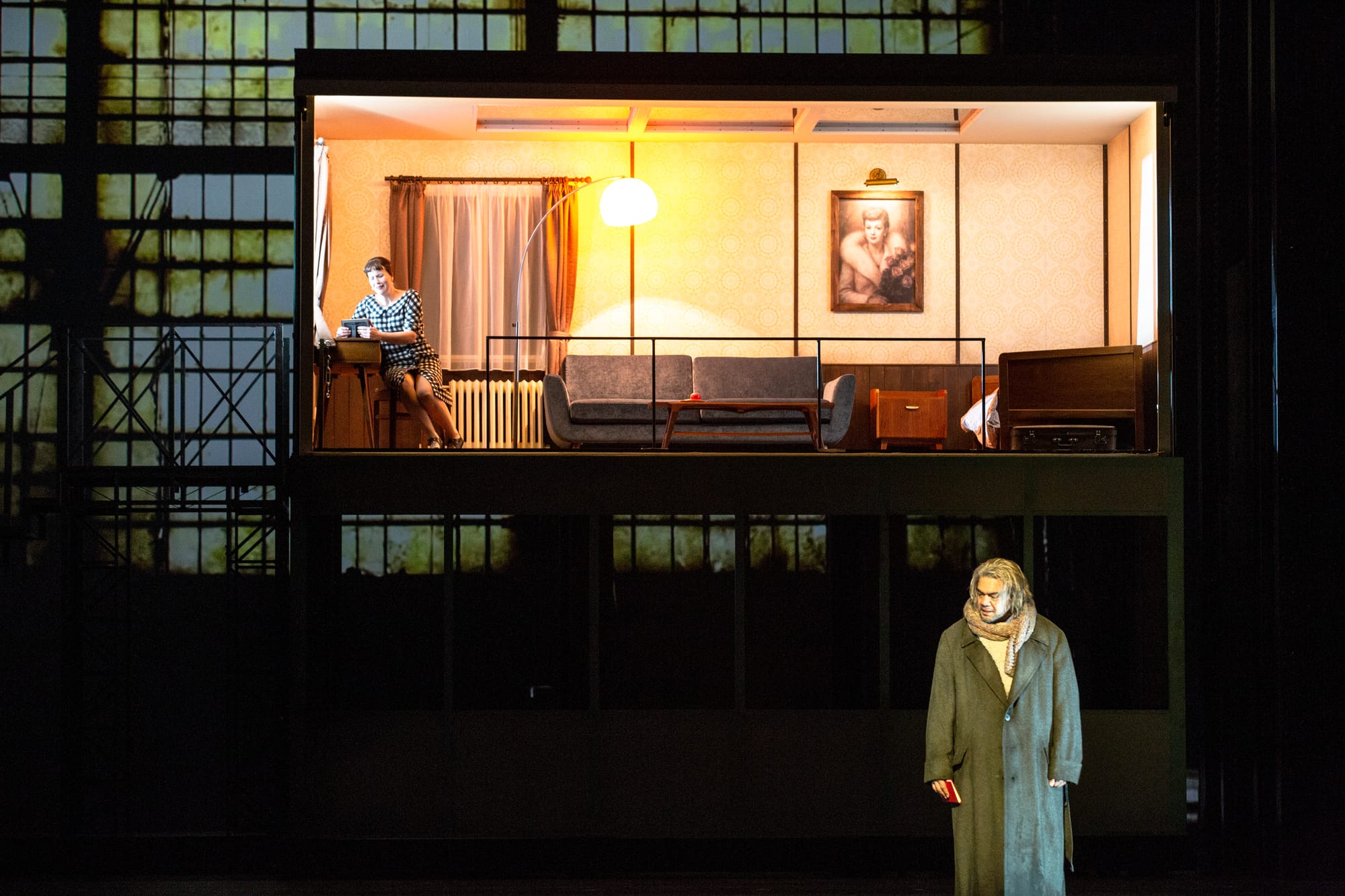
The Antonia act is the one I found hardest to enter, and I'm not entirely sure I can account for why—which is itself a kind of data point, given how clearly the other two acts landed. Antonia is the daughter of a violin maker who has forbidden her to sing because her mother, an opera singer, somehow died of it; Hoffmann loves her and wants to marry her, but quietly, gently, under the pressure of that love, also wants her to stop. He takes on the shape of the father's prohibition without quite realizing he's doing it, which is—to be fair to Hoffmann, and to men generally—probably the most realistic thing in our plot.
What Steier does with this setup is to cast the devil—the evening's designated agent of chaos and destruction—as the act's unlikely feminist ally: it's the villain who tells Antonia not to give up singing, who argues against the suffocating protection of men who love her, who insists, essentially, on her right to her own voice. Don't give up singing, you've got to do this, girl—from the mouth of the devil, which is either a provocation or an indictment of everyone else in the room, or possibly both.
The irony is almost too clean, except that it doesn't resolve neatly: Antonia doesn't survive her agency; she dies, but not of the curse the libretto originally gives her. Instead, in a kind of act of agency, she kills herself. Whether that constitutes emancipation or its negation is a question the production declines to answer—and it's probably right not to, even if I left the act wanting something I couldn't quite name.
Cocaine at the Gay Bathhouse
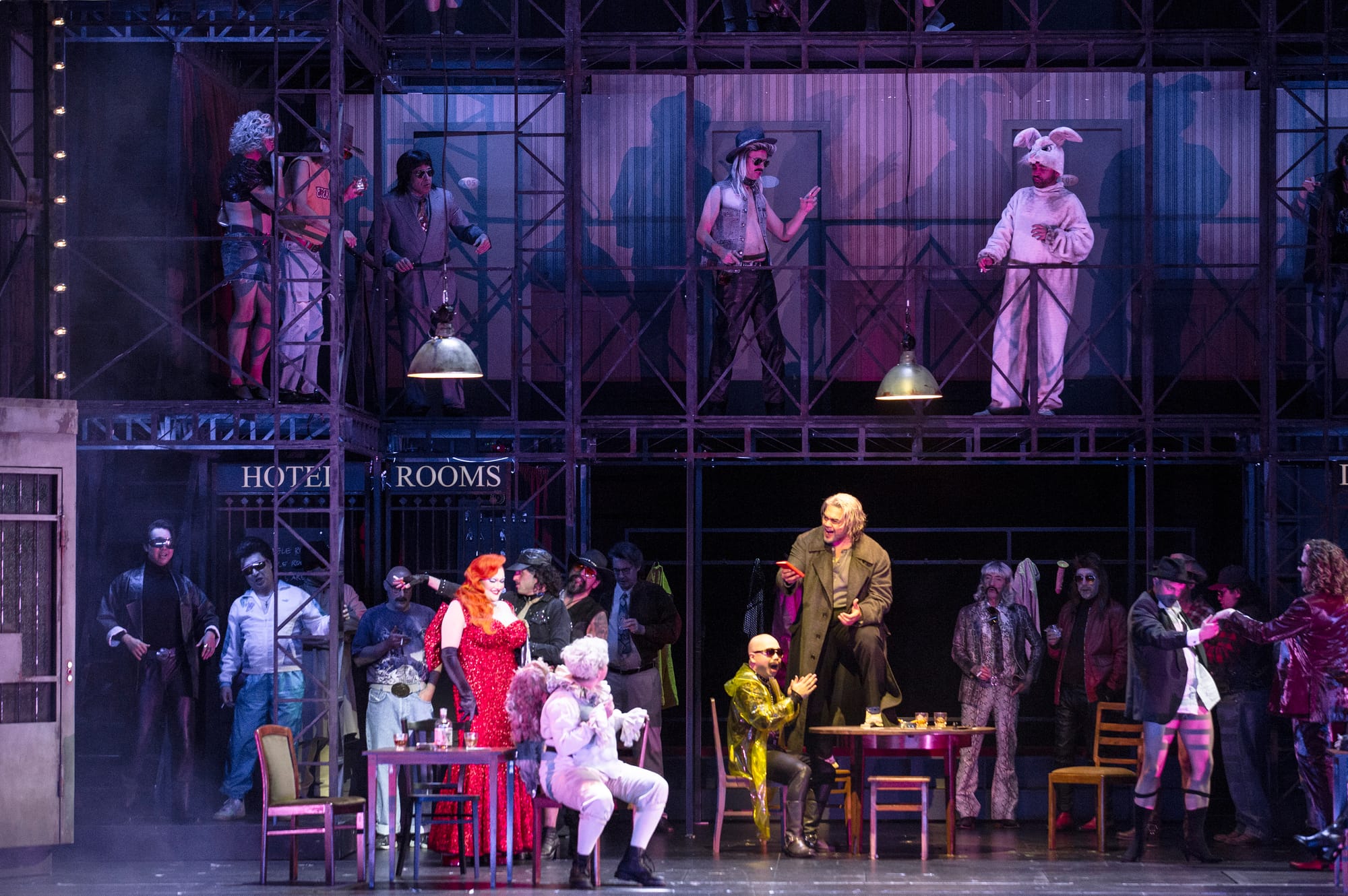
By the third act, Hoffmann has traveled some distance: from a child in a department store wanting the wrong toy, to a man in a brothel that is—there's really no other way to describe it—a gay sauna, complete with men in towels disappearing into rooms and a tray of cocaine being passed around with the casualness of a canapé service. It's a Thursday night in Berlin, the production seems to say, in the way Berlin productions occasionally wink at themselves for being Berlin productions. Whether you find this charming or slightly gaudy probably depends on how many Thursday nights in Berlin you've had.
Giulietta herself—a Jessica Rabbit-Tinkerbell hybrid, spectacular and deliberately hollow—is the logical endpoint of a journey that began with genuine longing and has arrived somewhere closer to transaction, the difference between a child's desire and an adult who's stopped expecting desire to mean anything. There may also be a genuinely queer element to Hoffmann's presence in this particular space, something the production gestures toward without quite committing to—and given what the Olympia act set up, the non-committal feels like a missed opportunity, a thread left hanging in a piece that has otherwise been admirably willing to follow its ideas to uncomfortable places.
What follows is the evening's final surprise: Hoffmann kills Giulietta, but accidentally. A misstep rather than a crime, and the production softens it accordingly. the elevator—present since the opening, its purpose never in doubt—ascends, the Pearly Gates open, and Hoffmann disappears upward—absolved, redeemed, and on his way. It is, by this point, a pattern: the production has been quietly softening Hoffmann's ledger all evening, and the question of whether that's generosity or excuse is exactly what the final act inherits.
Go to Therapy, Man
It would be easy to resist this ending, and I understand the resistance: a man who leaves a trail of damaged and dead women behind him, redeemed because he was sad underneath, given his apotheosis and sent upward while the audience claps—it has the shape, if you squint, of exactly the kind of artistic exculpation that serious people are rightly tired of.
And yet. The production's program includes an excerpt from bell hooks on masculinity and romance, and frames Hoffmann explicitly as a man who learned to love inside patriarchal structures—structures that trained him to read gentleness as weakness, trust as exposure, the wrong desire as something to be ashamed of in a department store at nine years old in front of everyone—and what Steier is ultimately staging, I think, is not an absolution but a case study: here is how damage propagates, here is how an unhealed interior life becomes other people's problem, here is a man who needed therapy and never got it and died a sad drunk in front of a peep show on a street that looks like an Instagram post.
The takeaway, if we're being blunt about it, is: go to therapy, man—before you ruin anything else, before the women in your life pay the cost of your unexamined childhood, before you end up in purgatory with Elvis. It's not a comfortable thesis, and it's not meant to be, and the fact that Offenbach's score—abundantly, almost extravagantly beautiful, delivered by a cast with Bernheim at its center—keeps pulling you toward sympathy even as the staging insists on accountability is not a flaw in the production's argument but its most honest gesture: because that's exactly how it works, in life, with people like this. The music makes the case for them. You feel it before you can think your way out of it. And then you're left, in the dark, with both things true at once.
That, I am convinced, is what opera is for.


Cast - 05.03.2026
Musical Director: Pierre Dumoussaud
Director: Lydia Steier
Stage, Video: Momme Hinrichs
Costumes: Ursula Kudrna
Light: Olaf Freese
Choreography: Tabatha McFadyen
Chorus Master: Dani Juris
Dramaturgy: Maurice Lenhard, Christoph Lang
Hoffmann: Benjamin Bernheim
Olympia: Regina Koncz
Antonia: Siobhan Stagg
Giulietta: Sandra Laagus
Lindorf, Coppélius, Dr. Miracle, Dapertutto: Alex Esposito
La Muse, Nicklausse: Samantha Hankey
Cochenille, Frantz, Pitichinaccio, Andrès: Andrés Moreno García
Luther: Irakli Pkhaladze
Hermann: David Oštrek
Nathanaël: Junho Hwang
Spalanzani: Florian Hoffmann
Crespel: Stefan Cerny
Stimme aus dem Grab: Natalia Skrycka
Schlémil: Jaka Mihelač
Die alte Dame: Brigitte Eisenfeld