Mittwoch aus Licht at Deutsche Oper Berlin
A desert altar, four helicopters, a camel elected president of the universe - and the question of what a new opera administration owes the public it hasn't yet won over.
🎭 Mittwoch aus Licht
🎶 Karlheinz Stockhausen, 1995-1997
💭 Susanne Kennedy, 2026
🏛️ Deutsche Oper Berlin
🗓️ 20.09.2026
An altar in the desert
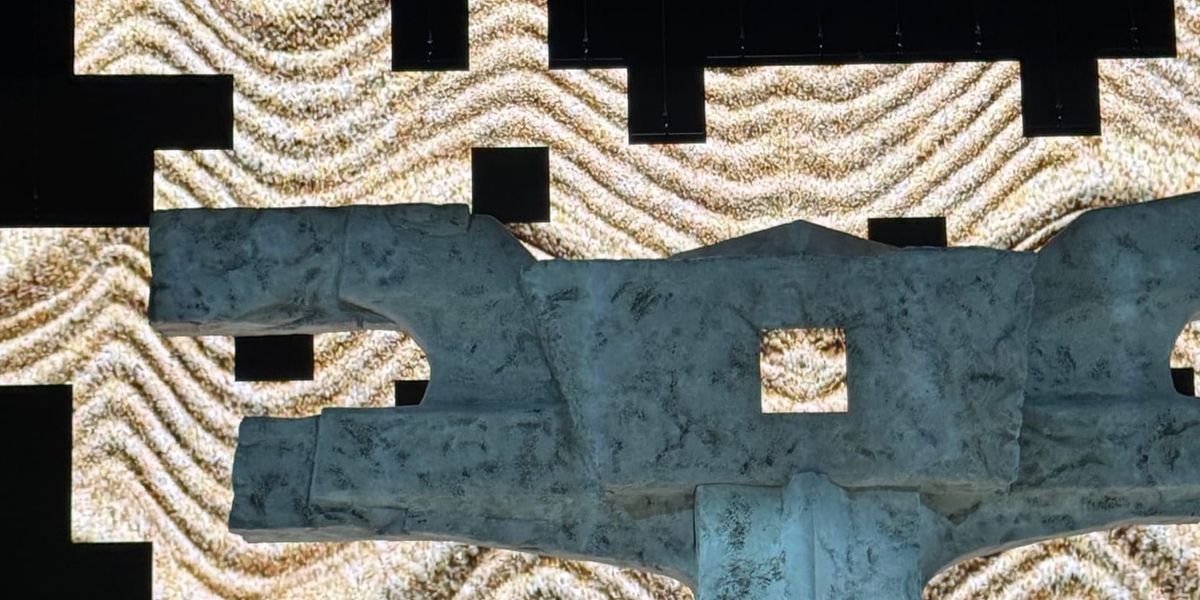
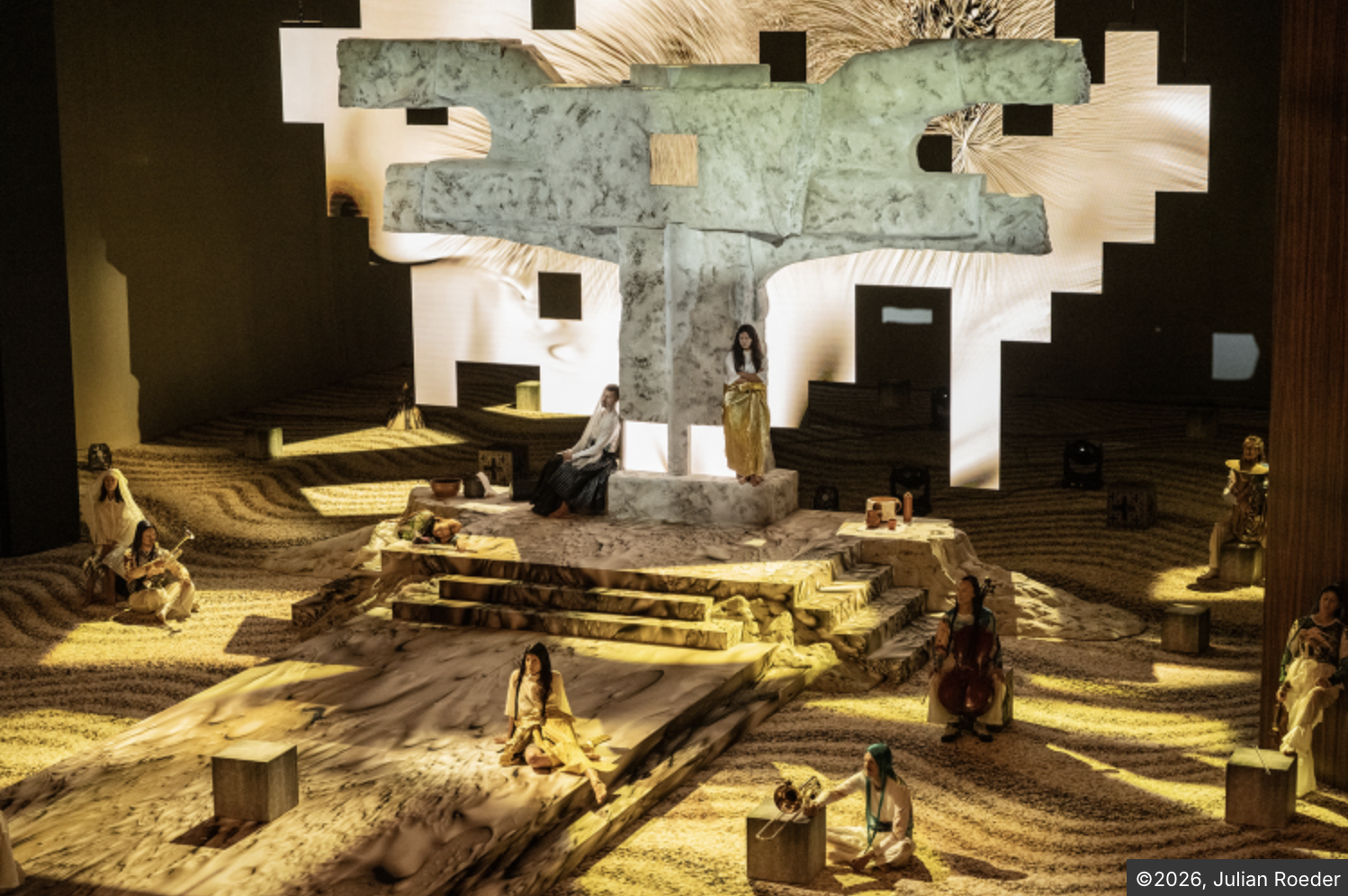
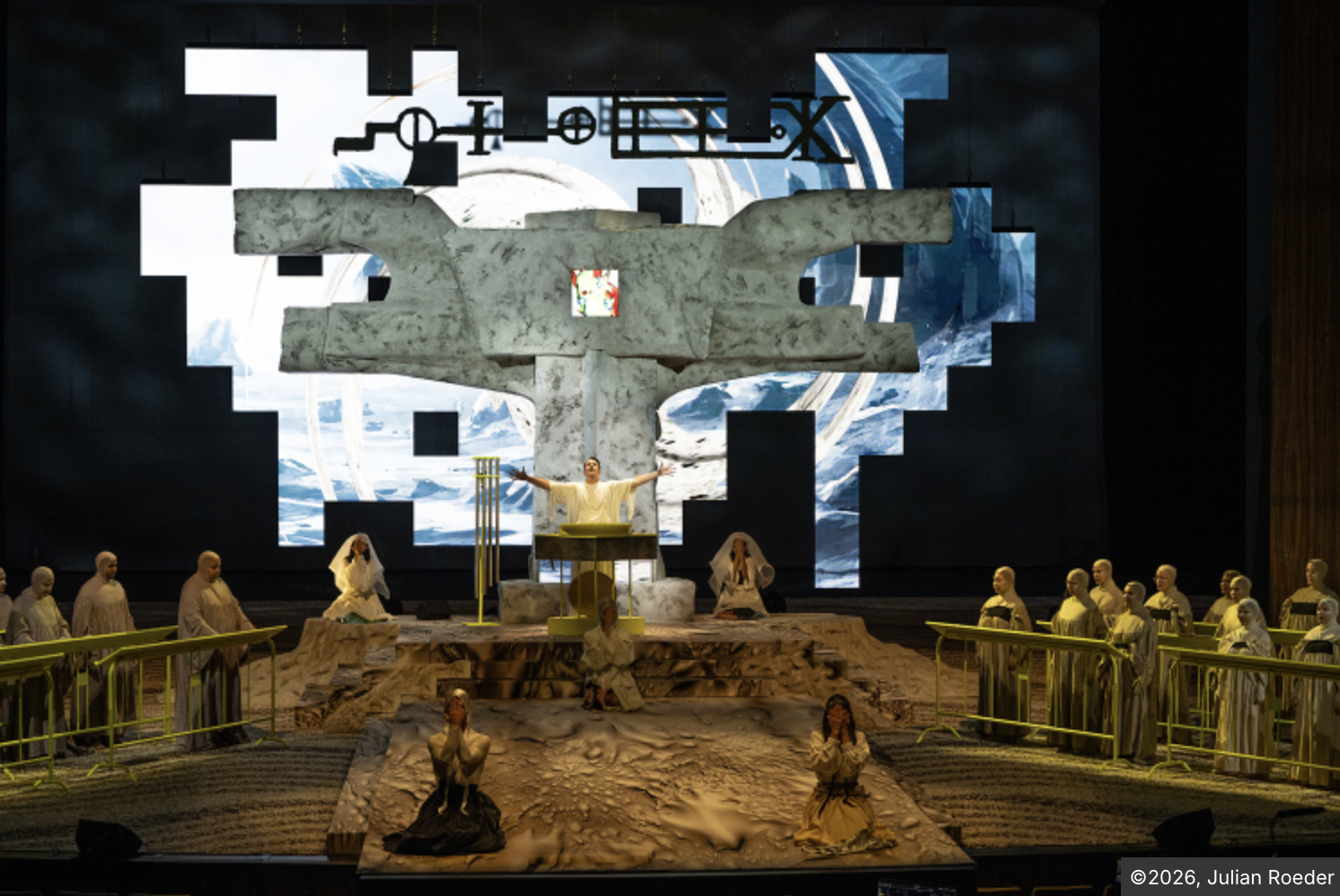
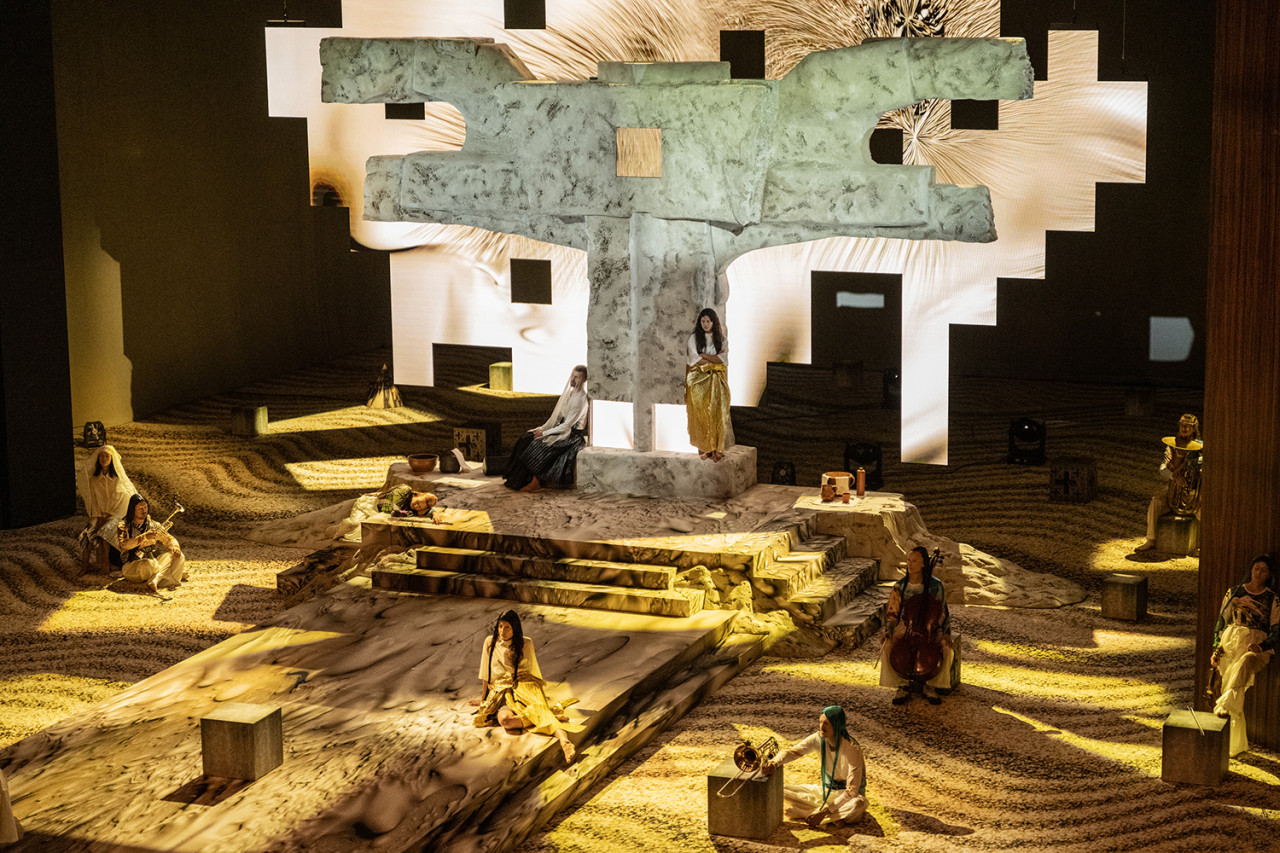
Aviel Cahn's first premiere as Artistic Director of the Deutsche Oper Berlin opens on a desert: a full futuristic wasteland, somewhere between Mad Max and Dune, with a monolithic stone structure at its center that equally evokes Stonehenge and 2001: A Space Odyssey, video screens flickering among the stone. It looks less like an opera set than a brutalist altar - and that turns out to be precisely the point, because that is more or less what Stockhausen has built here.
Licht, Die sieben Tage der Woche is the largest opera composition in history; twenty-nine hours across seven operas, one for each day of the week, on which its composer spent over a quarter of a century. Parallels to Wagner and his Ring are unavoidable: a composer-theoretician who pushed the genre's boundaries, who spent years researching religion (a devout Catholic upbringing, later Buddhism, noh theater, kabuki, Zen and voodoo ceremonies), who built a private mythology out of biblical figures, and who leaves behind a legacy at least as complicated as his pieces.
Michael and Lucifer in eternal conflict, Eve as mediator between them, and Wednesday - day of love, day of reconciliation, day of Mercury, day of air and of flying - as the day on which light figures as an optimistic power to change people's lives. Stockhausen restricted how the cycle may be performed, and it has never been performed in full. What the Deutsche Oper has now done is stage the entirety of Mittwoch aus Licht - four and a half hours, the full visual treatment, in an opera house - for the first time in Germany.
A ceremony in search of an audience
The word to hold onto is ritual. Mittwoch aus Licht has no linear plot; what it has is Handlungsgeflecht, a woven action around Eve, Michael, and Lucifer, and each of its four scenes stages some procedural ceremony: the World Parliament being constituted in the first, an a cappella choir of remarkable precision delivering a soundscape that carries something sacred, almost requiem-esque; the instruments of the second scene taking their turns as if in a liturgy (Wagner couldn't sound further away than here, where a trombonist groans into his instrument, one shout after another); and in the Michaelion, the fourth and final scene, the election of a camel from the galaxy Andromedar as president of the universe. Even the foot-washing - with pails, with rags, performed by the movement ensemble - reads as rite rather than drama: Parsifal, if Parsifal met Dune and electronic music.
The performers reflect this: choir, dancers or silent movement actors, individual musicians scattered across the stage - there is no orchestra pit; the pit is covered, and a small pier extends into the audience so that one sits unusually close to the instruments and action - plus a camel whose post-election job, naturally, is operating a radio. The framework the piece proposes is quasi-religious, and this is where the piece is most itself, and where the production serves it best: each scene is a ceremony conducted with total seriousness, and the seriousness is earned.
From spectacle to screensaver
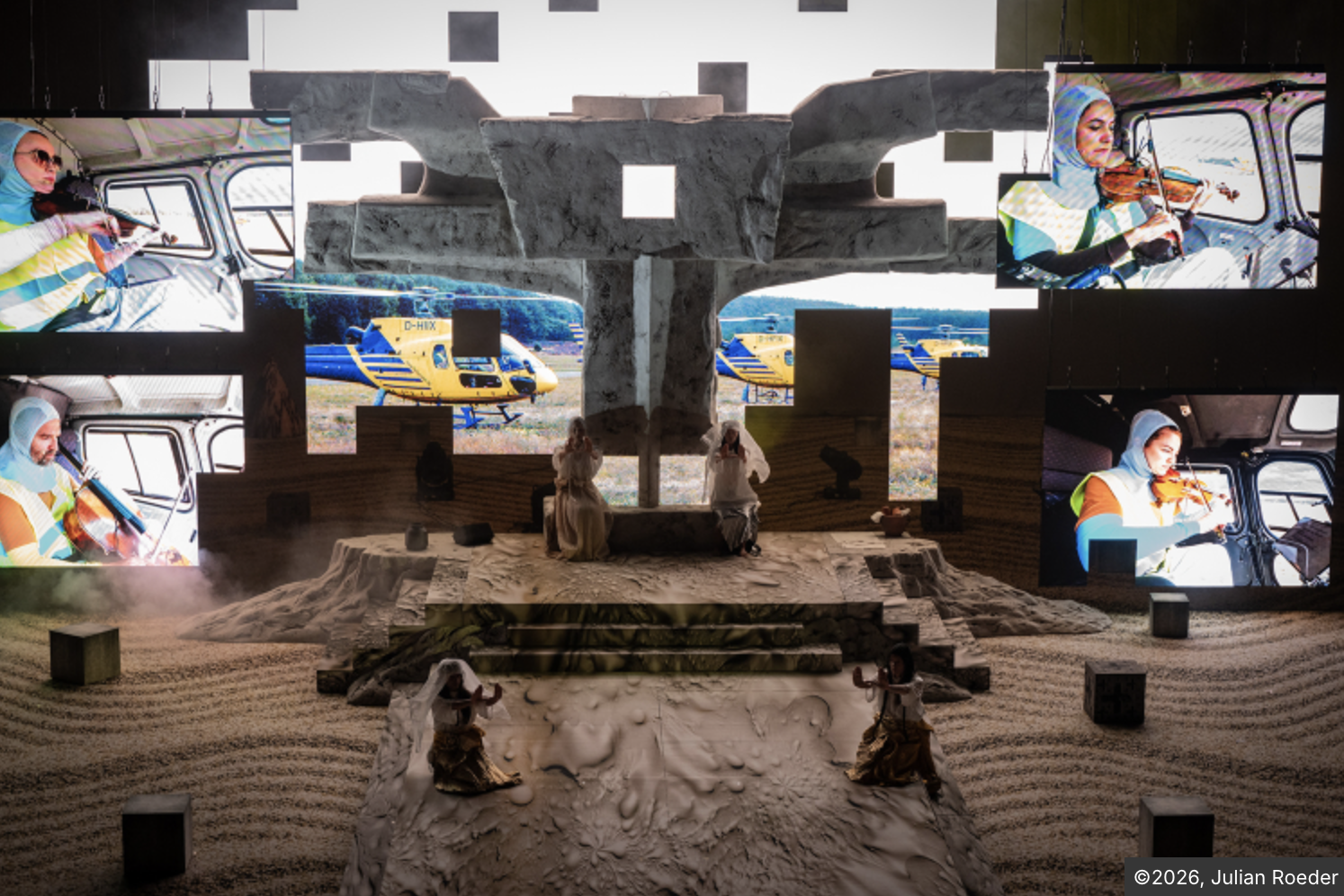
The third scene is the infamous Helicopter String Quartett, and there is no way around describing it literally: a string quartet in which each musician sits in a helicopter, the four aircraft taking off, flying in formation, and landing while the rotor sounds and the instruments interpenetrate, the players synchronized not by hearing each other but by click tracks played into their ears. It was performed live in Berlin specifically for this run, privately funded by supporters of the house, and the production handles it as honest documentary: Stockhausen's own voice introduces it from the original 1995 Amsterdam performance, four screens descend showing the cockpit views, rising and falling as if flying.
And so for twenty-five minutes, you sit in a dark auditorium watching four helicopters hover over an airfield just outside the city, the sound distributed around the room, fans blowing rotor wash into the audience like a 4D cinema ride. The feat is genuinely impressive - synchronization across four moving aircraft is an absurd technical demand, and it works. It is also twenty-five minutes long, and halfway through the impression curdles from I can't believe this is happening into okay, we get it. The moment of liftoff is a spectacle; the remaining twenty is a screensaver with strings.
Machine-made, or made to look like it
Then there is the matter of the videos. Either visual effects artists spent significant effort making human work look like AI-generated slop, or AI-generated slop was used on stage at a state-subsidized opera house - and either way, the audience watched three hours of cathedrals shooting out of the ground, buildings assembling and dissolving, AI birds flapping around DJI drones and winged children, in exactly the aesthetic of the generative slop that floods our feeds. I can't prove what pipeline produced it, but I can report that it looked like that, unmistakably, and that its function in the performance was that of Subway Surfers beneath a Reddit post: a flickering digital movement to distract from the routine of what was happening on stage.
Whatever one thinks of Stockhausen's noise scapes - and much of the music I would, optimistically, describe as experimental soundscape - there is an intellectual dilemma here that has nothing to do with taste: generative AI is being absorbed into every industry, and a craft institution whose legitimacy rests on the human labor of singers, players, and designers has chosen, or at least not visibly avoided, an aesthetic that announces itself as machine-made. In a piece whose entire claim on us is the ceremonial presence of human bodies performing irreplaceable actions, the backdrop advertises replaceability.
Which makes the counter-image all the more striking: between the video slop, the soundscapes that demand patience, and a libretto that refuses to mean, you spend much of the evening digging, almost archaeologically, for something to hold onto. It's the actors who finally find it with their hands: sculptures formed out of clay - anthropomorphic figurines, one of the oldest art forms in human history - hands visible, material tangible.
The wrong room, or the right signal?
I want to be careful here, because I mean this as a question about the institution, not a verdict on the artists: a great deal of work went into this production, people from the performance art world were obsessed with it, and I strongly believe all art is valid.
But I kept circling one thought: who is this piece for? It seems to belong more to an event like the Venice Biennale or Berlin Art Week - venues where one moves freely, spends time with an installation, approaches and retreats, watches video art the way video art asks to be watched. Stockhausen was among the first of the genre to understand that the boundaries between art genres were dissolving; that insight cuts both ways. He was also specifically not Wagner, who essentially invented the performance space we sit in today to consume this art: a dark auditorium, hours-long stillness, no interaction with the work, only its display. Pinned to a seat for four and a half hours, unable to choose my own duration, Mittwoch felt less like an experience and more like a proof of concept - and I closed my eyes, often, just to listen.
Coherent positioning, persuasion to be confirmed
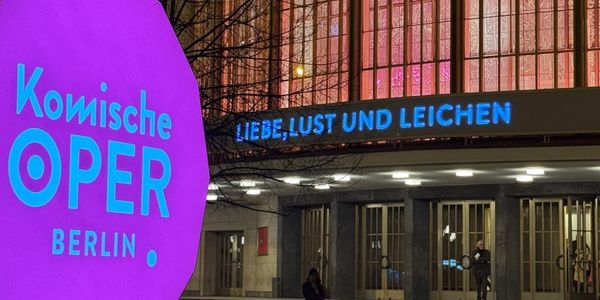
The deeper question is what this premiere reveals about the house. This is a new administration's opening statement: a season under the motto Make Love..., a new corporate identity, new edgy uniforms with Berlin label 032C, new flags, a Fatboy chill zone in the foyer (all while the program booklets still can't be paid for by card). The New York Times profiled the piece alongside the new Director and gave some industry context: three opera houses in Berlin, the Komische Oper and the Staatsoper selling over ninety percent of seats across a season, the Deutsche Oper - largest of the three - only about seventy-five, which is a gap you can often feel in the room.
Against that backdrop, the strategy is legible: to sharpen the house's profile, to differentiate, to justify the abundance of three subsidized houses by making one of them the radical one. As positioning, Mittwoch aus Licht is coherent. Whether it is also persuasion is another matter: the premiere run did not sell out, Tosca with a stellar cast just following it didn't either, and there is something worth sitting with in the optics of a publicly supported house flying four helicopters over Berlin, however privately funded, in a city where people can't afford groceries, in a political moment when artistic abstraction itself is under attack from reactionaries, when cultural budgets are being cut and modern art's public subsidy is being questioned.
What lingers
I don't think staging radical work at state opera houses is wrong - there is a real argument that this is precisely their function. But there is a difference between an institution making a case for difficult art and an institution staging radical work without being able to say - to its donors, its subscribers, and its city - just why. I have spoken with longtime supporters of the house who dislike essentially everything the new administration is doing. One can say they'll have to come along or fall away; one can also ask what an opera house is left with when the parts of its audience with the deepest loyalty and the financial resources to match it conclude that the house no longer makes anything for them. That is the structural conflict I see no solution to: opera in 2026 is called dusty and elitist, so it modernizes, politicizes, radicalizes - and in doing so alienates the very people who sustained it.
The reviews of Mittwoch aus Licht were as polarized as the piece; if polarization was the goal, it succeeded. I am less and less sure that in polarized times, polarization is what our opera houses should be contributing. Maybe some forms of art can be about bringing people together. Der Fliegende Holländer premieres today - the second new production of this administration. We will see which audience shows up, and who keeps showing up after.

Creative Team
Conductor Maxime Pascal
Director Susanne Kennedy
Stage design Markus Selg
Concept Markus Selg, Susanne Kennedy
Costume design Andra Dumitrascu
Light design Marcel Weber/MFO
Sound projection Florent Derex
Sound projection Assistant Nicolas Widmer
Computer Music Designer Augustin Muller
Video Warja Rybakova, Markus Selg
Dramaturgy Beate Breidenbach
Conductor «World Parliament» Jeremy Bines
For full cast, visit Deutsche Oper website