Violanta at Deutsche Oper Berlin
Psychoanalysis as science fiction: rooms within rooms, each one a door into what you've buried—some doors you open, and some you don't.

🎭 Violanta
🎶 Erich Wolfgang Korngold, 1916
💭 David Hermann, 2026
🏛️ Deutsche Oper Berlin
🗓️ 29.01.2026
"LOCKE NUR, DU BUHLERISCHER TRAUM"
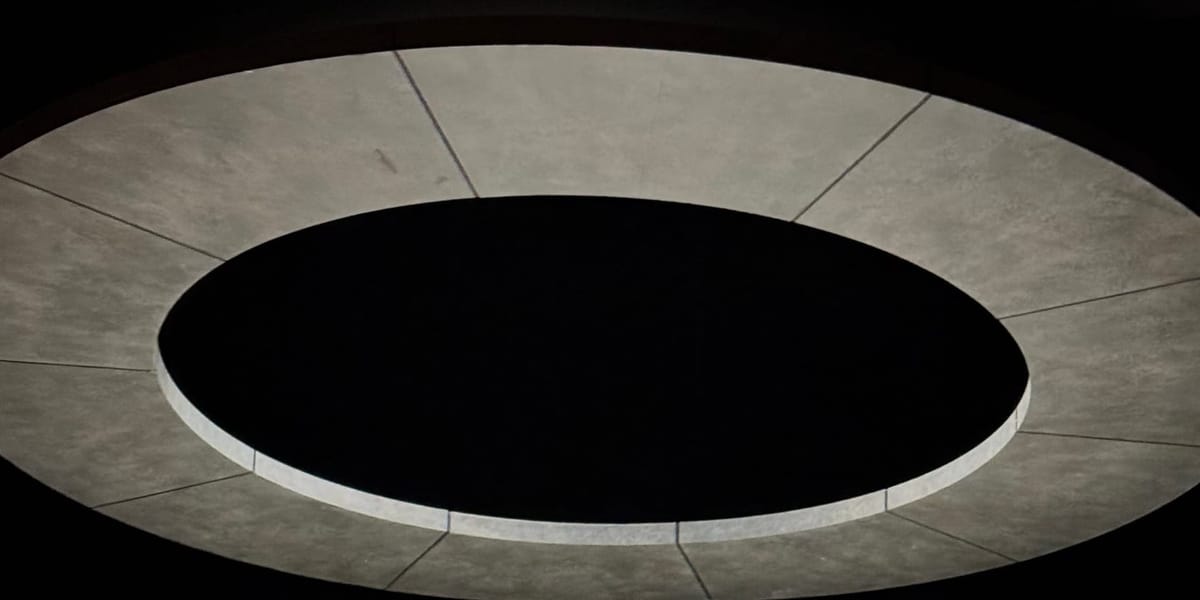
There’s something almost defiant about setting an opera about self-discovery in outer space. The work of looking inward—really looking, past the stories we’ve rehearsed about ourselves into the murkier rooms underneath—is unglamorous, often tedious, and requires confronting things that don’t go anywhere neat. It is not the stuff of Dyson rings and avant-garde purples. And yet here we were: Erich Wolfgang Korngold’s Violanta, a new production at Deutsche Oper Berlin, staging the most fundamental of psychological labors in what felt like the interior of a spaceship. I kept thinking: maybe that’s the point.
I should say upfront that this was my first Korngold opera, which meant I came in for the introductory talk and I’m glad I did. The detail that landed hardest: Korngold was eighteen when he composed Violanta. Eighteen, with access to a full orchestra, and the ambition to use every last piece of it. You can hear this—not as excess, but as someone who has been handed an instrument capable of anything and refuses to waste the opportunity. The music is grand and genuinely overwhelming at moments, with an undeniable cinematic quality that shouldn’t be surprising given Korngold’s later Hollywood career but still catches you off guard. There were stretches that felt like silent film accompaniment—Metropolis came to mind—where the orchestra isn’t underscoring the drama so much as being it, carrying the emotional weight that the libretto alone can’t hold.
The production begins before Violanta begins. A John Dowland lute piece—Renaissance, filigree, almost private—opens the evening, framed as a musician playing for Violanta. Then comes the Prelude to Alban Berg’s Three Orchestral Pieces, more interior still, more inward-facing. The effect is of progressive depth: something ornate gives way to something starker and stranger, before Korngold’s own maximalism takes over. It’s an elegant frame that announces the production’s central preoccupation.
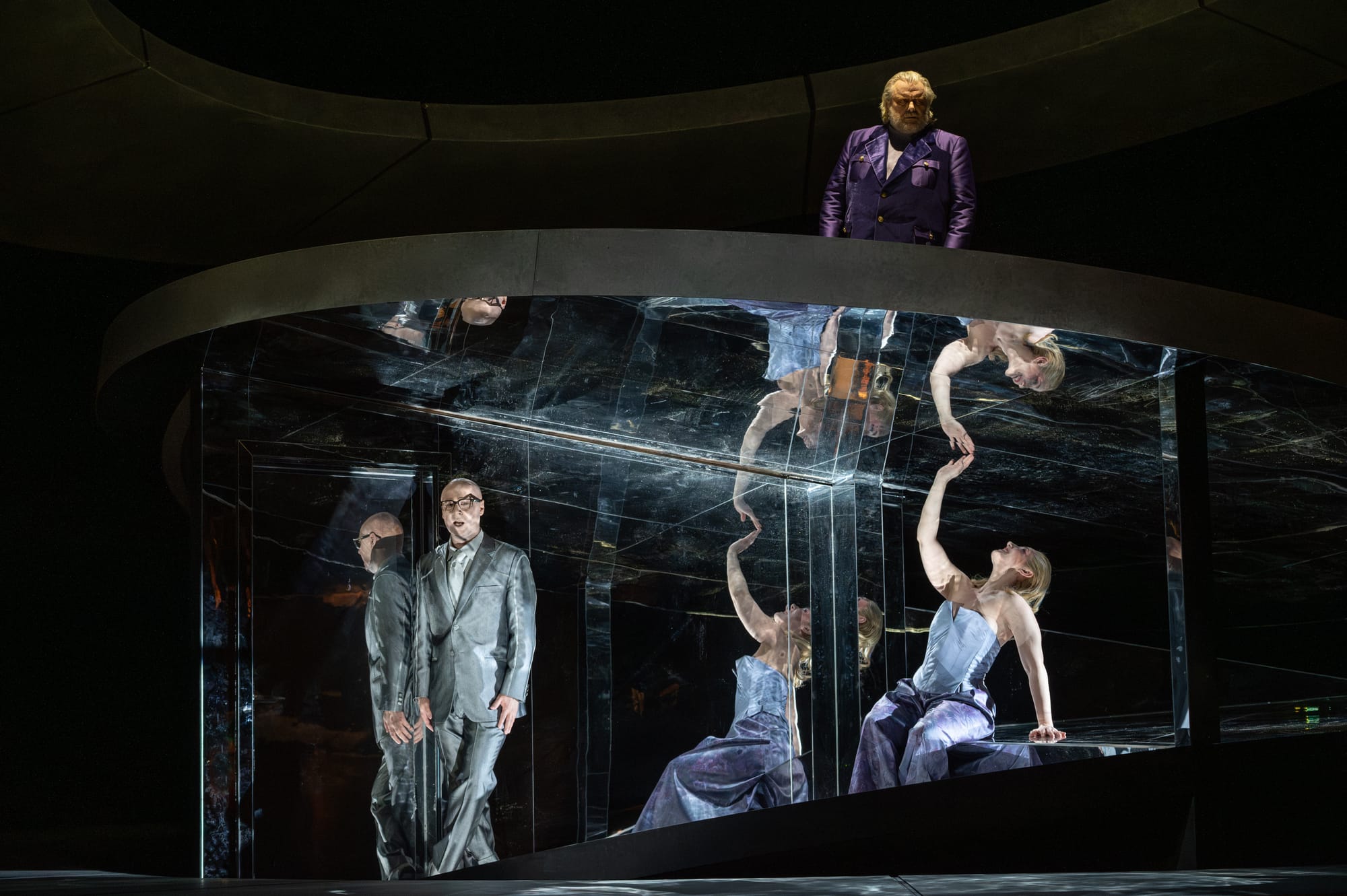
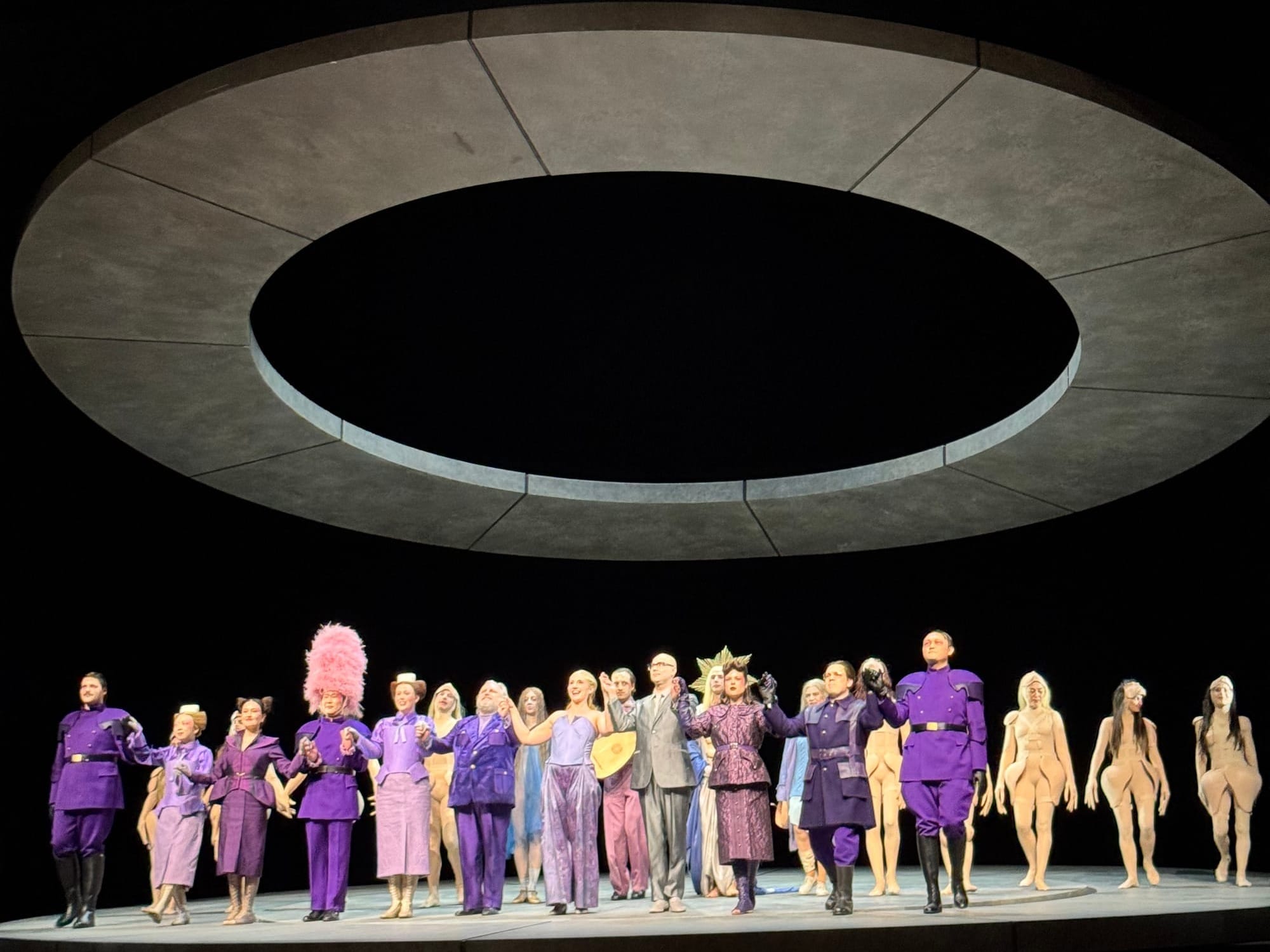
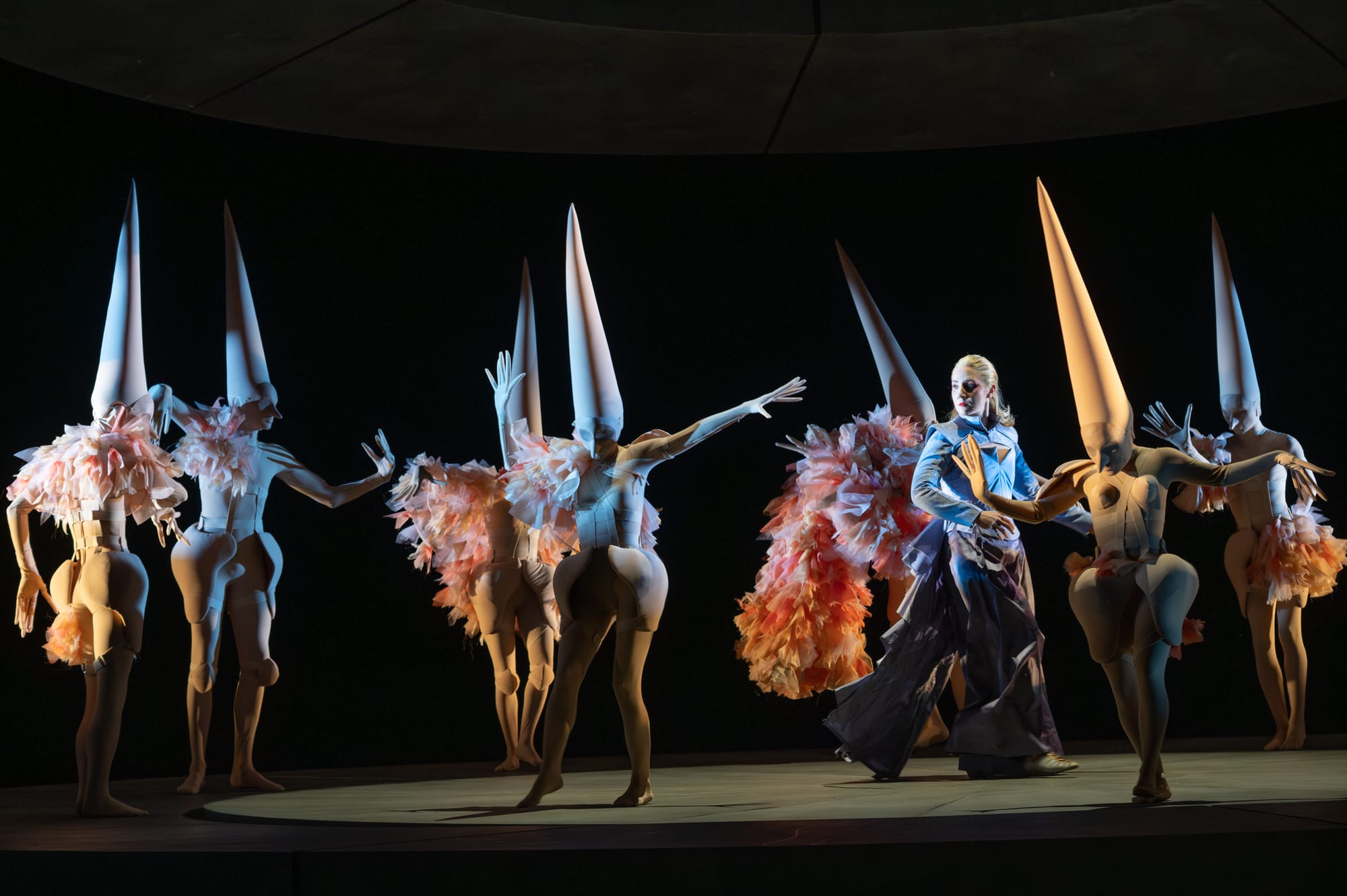
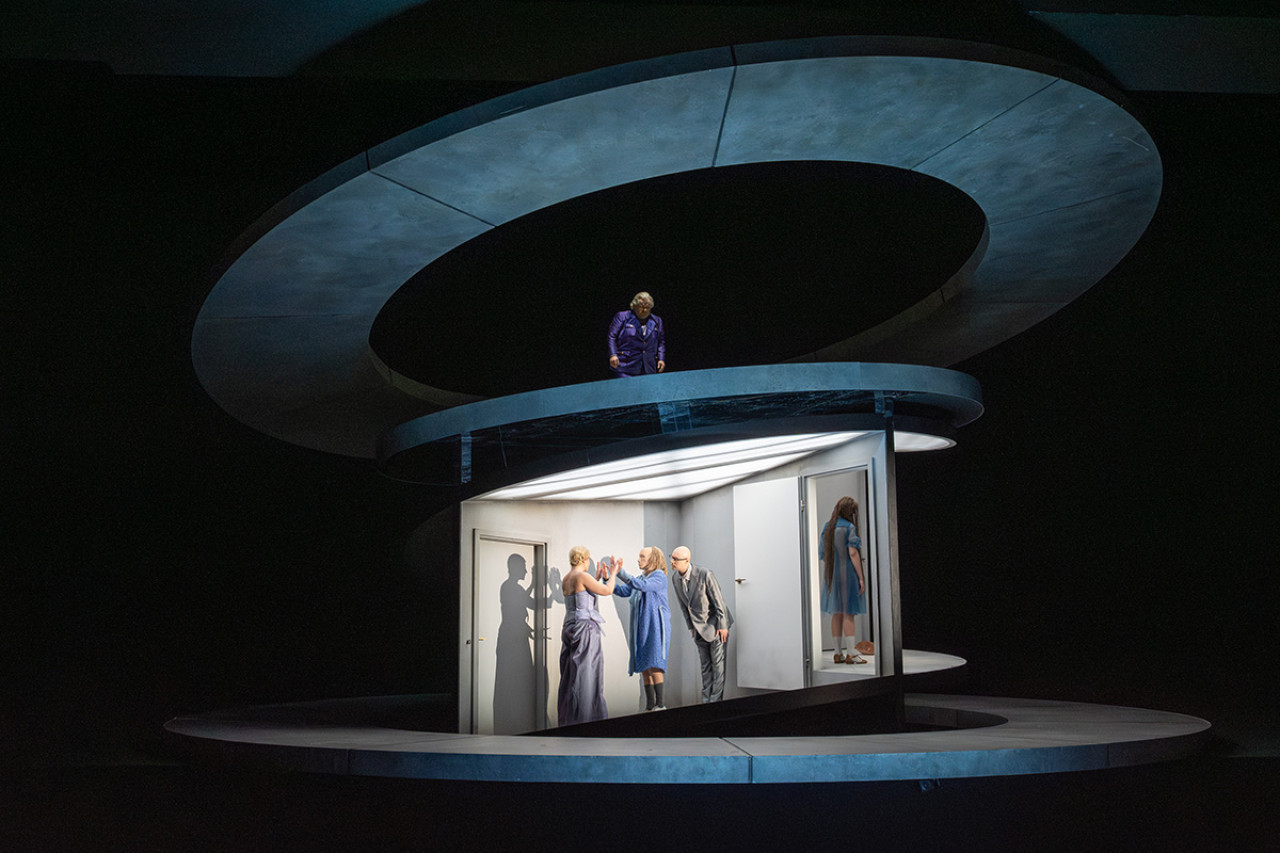
The set makes this literal. A large screw—flat at first, almost architectural—begins to turn as Violanta descends into her own psyche, revealing rooms beneath rooms: a chamber of mirrors, a room for her dead sister, another for her mother, one for lust. The deeper she goes, the more the stage looks like some kind of orbital station, all clean geometry and deep shadow. The hovering ring above the stage casts light like a simulated sunset; the black stage floor gives the impression of looking at an artificial planet from above. The costumes—bold primary colors, structural cuts in dark purples and saturated tones—confirm the register. This is not quite fairytale, not quite fantasy. It’s science fiction as psychological theater.
Which is genuinely interesting as a production choice. Westworld kept surfacing in my mind: the rooms Violanta enters are frozen until she touches them, mannequins becoming people at her approach, freezing again when she leaves. She moves through memory like Dolores—activating it, metabolizing it, trying to understand what it’s made of. The Familienaufstellung comparison feels right too, that therapeutic model where you physically inhabit relationships to understand them differently. What the staging captures is how exhausting this kind of work actually is. That it takes something out of you, that the rooms don’t unlock passively, that you have to enter them on purpose.
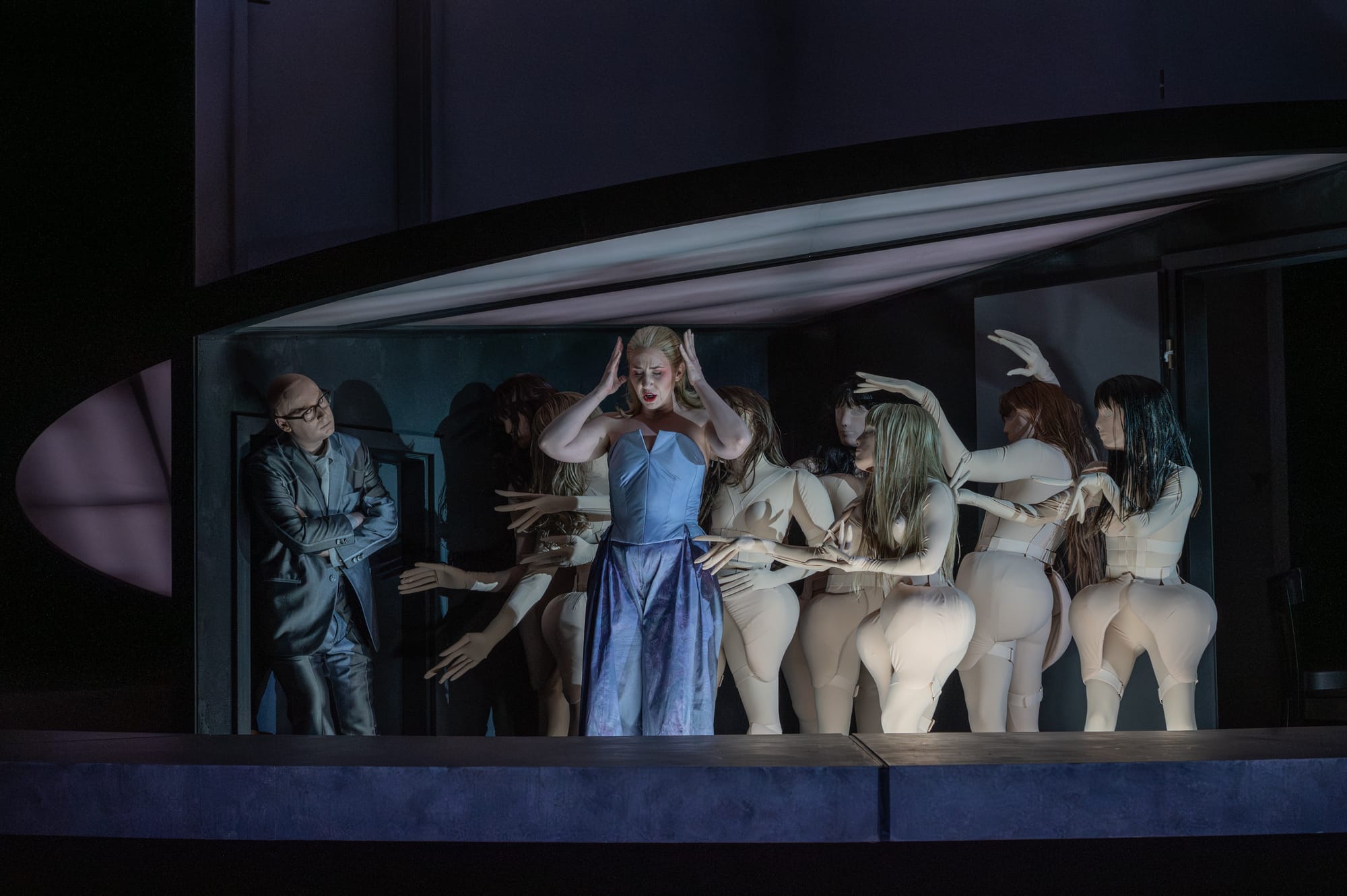
Korngold was working within the psychoanalytic ferment of his time, and the opera’s plot reflects that somewhat uncomfortably—Violanta plots to seduce and kill the man who destroyed her sister, only to discover that what she wants to extinguish is her own desire. It’s a psychologically acute story dressed in a moralistic frame that hasn’t aged evenly. The question of female agency in opera is one I keep returning to, partly because the genre keeps refusing to let it go. This production, to its credit, refuses the original ending. Violanta is supposed to die (naturally, because she is a woman who felt something) but here she catches the bullet. Time slows; she holds it; she carries on. I don’t know exactly what it means, but I found it quietly moving. An act of authorial refusal. An acknowledgment that we’ve seen this other ending enough times.
The final door in the screw-stage, the deepest room, remains closed. Violanta stops short of whatever’s in there. Maybe there’s always a door you don’t open—at least not yet, not this time. What this production argues, more convincingly than most, is that stopping there isn’t failure. The work of getting that far is itself the thing.

Cast - 29.01.2026
Conductor Sir Donald Runnicles
Director David Hermann
Stage design, Video Jo Schramm
Costume design Sybille Wallum
Light design Ulrich Niepel
Dramaturgy Jörg Königsdorf
Chorus master Jeremy Bines
Simone Trovai, Captain of the Republic of Venice Ólafur Sigurdarson
Violanta, his wife Laura Wilde
Alfonso, son of the King of Naples Mihails Culpajevs
Giovanni Bracca, painter Kangyoon Shine Lee
Bice, Violanta's chambermaid (singing) Hye-Young Moon
Bice, Violanta's chambermaid (playing) Lilit Davtyan
Barbara, Violanta's nanny Stephanie Wake-Edwards
Matteo Andrei Danilov
First maid Maria Vasilevskaya
Second maid Lucy Baker
First soldier Michael Dimovski
Second soldier Paul Minhyung Roh
Lute Pedro Alcàcer
Chorus Chor der Deutschen Oper Berlin
Orchestra Orchester der Deutschen Oper Berlin
Dancers of theOpernballett der Deutschen Oper Berlin