Nurejew at Staatsballett Berlin
A gay Soviet defector, a ballet banned in Russia, a director now based in Berlin—and a premiere that felt like the most important cultural event of the season.
🩰 Nurejew / Nureyev
🎶 Ilya Demutsky, 2017
💭 Kirill Serebrennikov, 2017 / reconstructed 2026
🏛️ Staatsballett Berlin / Deutsche Oper Berlin
🗓️ 19.03.2026 (General Rehearsal)
"SEINE HEIMAT SUCHT MAN SICH NICHT AUS"
A specter is haunting Europe—and it is a gay Soviet ballet dancer.
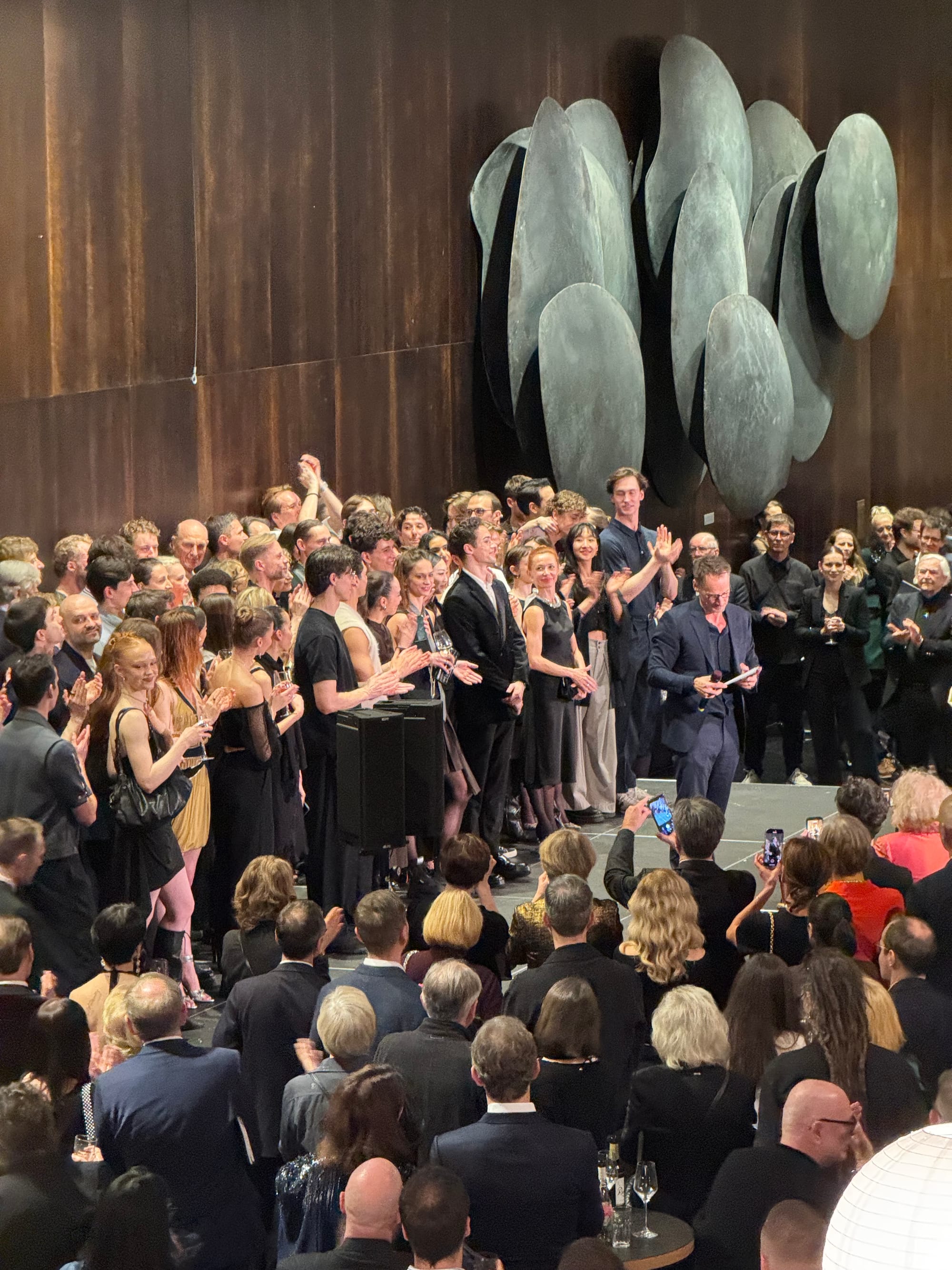
It's the most accurate description of what descended on Berlin this season when the Staatsballett brought Nureyev to the stage of the Deutsche Oper: a production so dense with history, so saturated with geopolitical resonance, so cosmically inconvenient for anyone who prefers their art uncomplicated, that attending the premiere felt less like seeing a show and more like being present at a cultural event. And it was one, unmistakably, almost overwhelmingly. The directors of Berlin's major houses were there. Ballet royalty with careers spanning the 20th century. Management of European ballet companies who had traveled specifically for this night. Something had arrived—though the question of what, exactly, is not as simple as it sounds.
The Story Before the Story
To understand why Nureyev landing in Berlin in 2026 carries the weight that it does, you have to go back—several times, to several different places.
First, there is Nureyev himself. Rudolf Nureyev was one of the most extraordinary ballet dancers of the twentieth century, trained in Leningrad, a star of the Kirov Ballet, and in 1961 the subject of one of the Cold War's most dramatic defections—slipping away from a Soviet delegation on tour in Paris at Le Bourget airport and claiming asylum. He was gay, and it was known. He lived accordingly—openly, exuberantly, in Paris and London through the 1970s and 80s, accumulating properties, art, lovers, and a reputation that incorporated genius, arrogance, and beauty in roughly equal measure. He died in January 1993 of AIDS-related complications. He was fifty-four. In the Soviet imaginary, and increasingly again in the Russian one, he was a traitor: a defector, a homosexual, a man who chose personal freedom over the glory of the collective.
Then there is Kirill Serebrennikov—a name that needs no introduction to anyone who has been paying attention to European theatre over the past decade. In 2017, when his Gogol Centre in Moscow was the most daring theatre in Russia, the Bolshoi commissioned him to make a full-length ballet about Nureyev's life. The pairing alone was extraordinary: a queer, progressive, artistically radical director making a ballet about a queer, defecting, artistically radical dancer for one of the most institutionally conservative stages in the world.
And so the piece was made: costumes were sewn, the choreography was set, and then—days before the premiere—the Bolshoi pulled it. The circumstances of what followed have since taken on the quality of legend: a general rehearsal proceeded anyway, was filmed, and the performance it captured was apparently so extraordinary that the theater reversed its decision. The premiere took place in December 2017. Serebrennikov did not attend; he was already under house arrest, facing charges of embezzlement that were later found to be baseless—but not before he had spent years confined, eventually leaving Russia and relocating to Berlin. His Gogol Centre was shuttered; he is here now. And so, finally, is Nureyev.
The piece was a sensation in Moscow and ran for several seasons until it was removed from the Bolshoi's repertoire in 2023, deemed in violation of Russia's anti-LGBTQ propaganda law. By then, the idea to reconstruct it in Berlin had long been underway.
That reconstruction—meticulous, years in the making, drawn from recordings of the original Moscow production—was the project of Christian Spuck, the Staatsballett Berlin's director, who saw Nureyev at the Bolshoi in 2020, having been talked into attending at the last moment. Spuck was so moved that he made a decision on the spot: when he came to Berlin, this would come with him. The Deutsche Oper stage is considerably smaller than the Bolshoi's, and the Staatsballett's company of approximately eighty dancers is less than half the size of Moscow's, so adjustments were necessary. But the intention was fidelity: to bring back, as closely as possible, the thing that had existed—and that Russia had decided it no longer wanted.
This is the production we are watching. Not a reimagining, not a commentary on the original, but the original, resurrected in a city that has positioned itself, deliberately and with some pride, as the place where such things survive.
The Auction and Its Contents
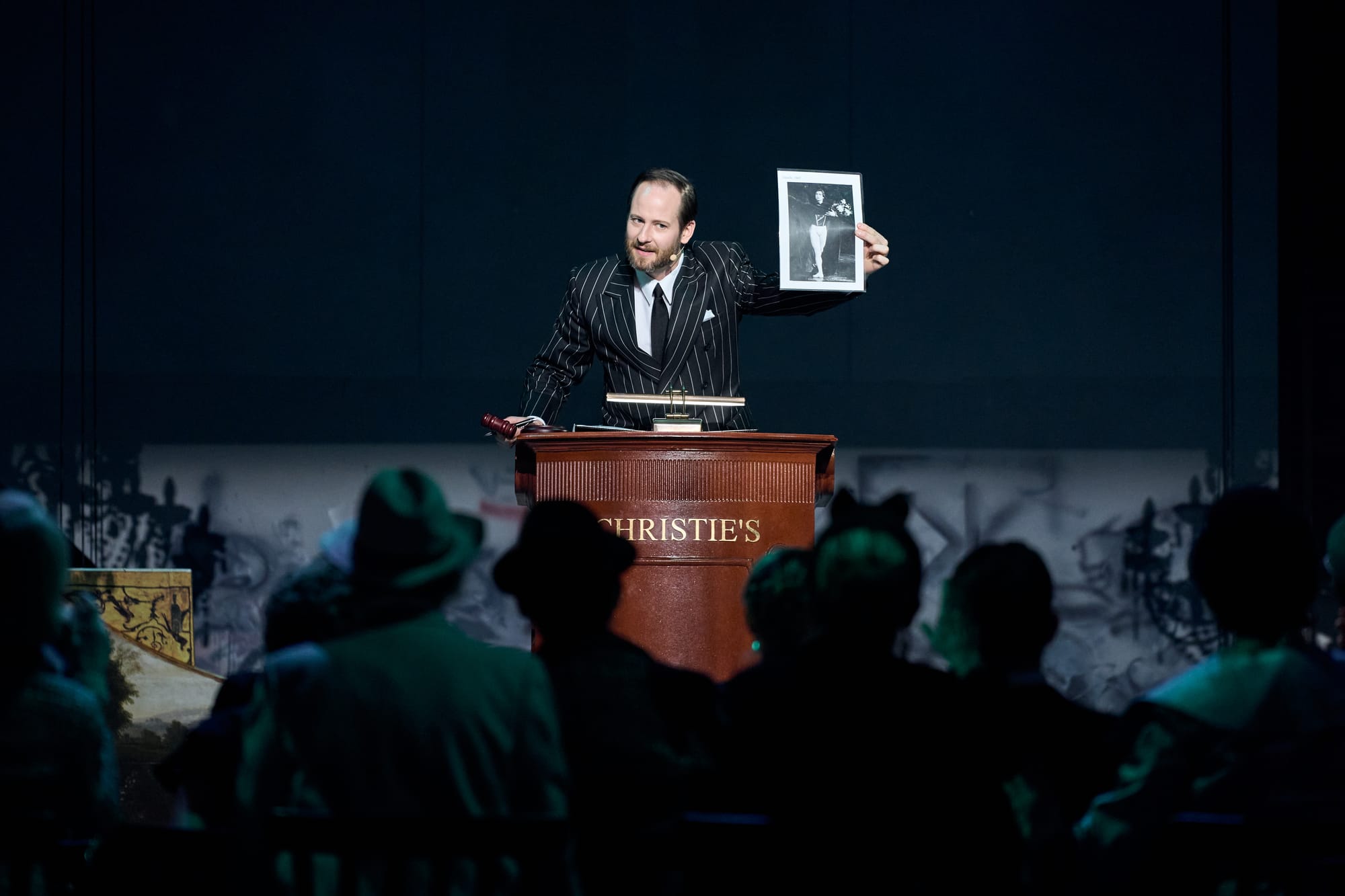
Nureyev opens on an auction. After his death, Nureyev's extraordinary estate—properties across Europe and the Americas, artworks, costumes, personal effects—was sold at Christie's in London and Monaco. Serebrennikov uses this auction as the production's framing device, threading through Nureyev's life by way of the objects that marked it. A lot is announced, time collapses, and we are somewhere else.
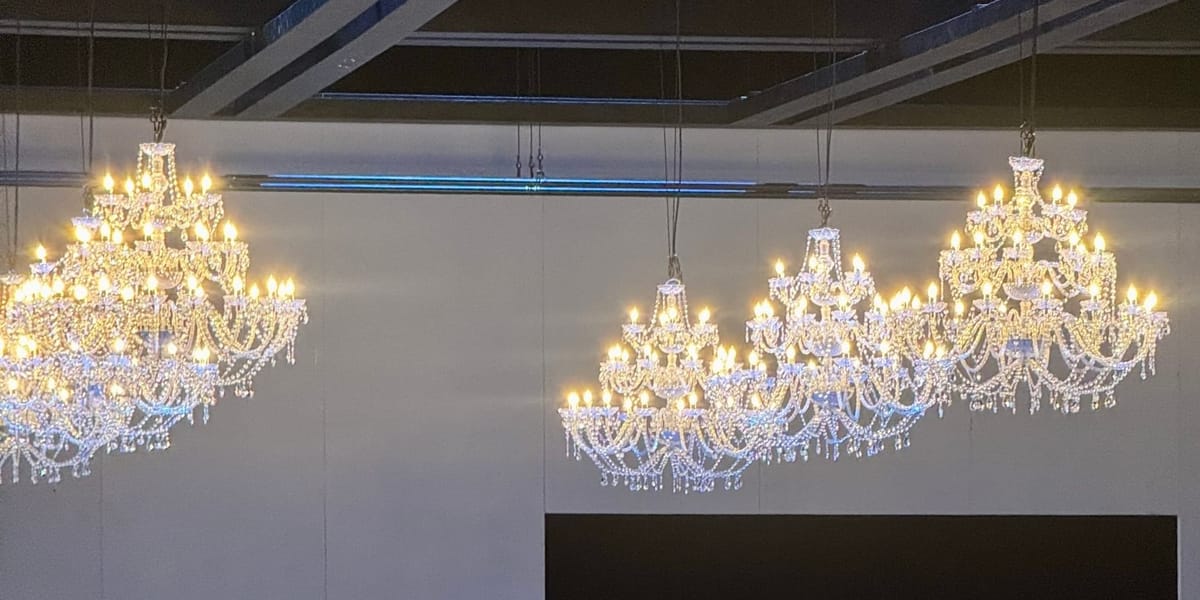
It is, I couldn't help but notice, the exact structural logic of The Phantom of the Opera—which is, after all, where the name of this blog comes from. Phantom also opens with an auction: decades after a fire destroyed the Paris Opéra, an elderly Raoul bids on a music box. The lot is announced, the chandelier rises, and we are taken back in time. Serebrennikov's auction opens with lot number 45. Whether or not Andrew Lloyd Webber's shadow reached to the Bolshoi, the parallel gave me a private, slightly amusing pleasure.
The auctioneer, the narrator who guides us through Nureyev's life, is played by Odin Lund Biron—who Serebrennikov cast as the Holy Fool in Boris Godunov at Dutch National Opera, with similarly extraordinary results. He is a superb presence: precise, humane, mercurial, capable of sudden stillness. Through him, we move from the Vaganova Academy in 1950s Leningrad—where portraits of the Tsar, then Lenin, then Stalin are swapped on the wall as political seasons change—through Nureyev's rise, his defection, his life in Paris, and finally his decline and death.
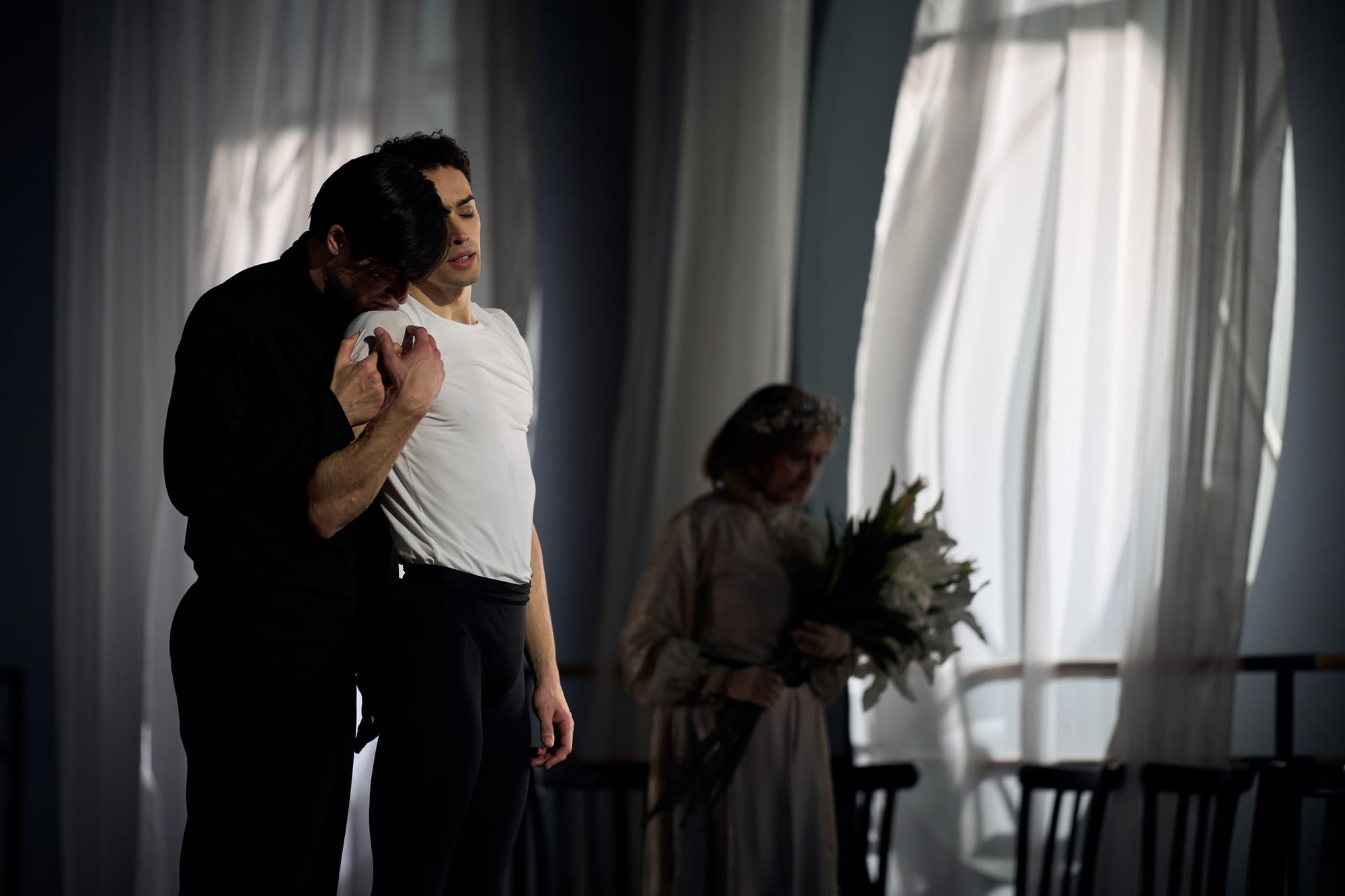
The production does not simplify him. We see a dancer of singular, almost alien talent; we also see him reduce the corps to tears, call his dancers faggots and fat asses, and perform the cruelty that often travels alongside genius. The correspondence sections—letters read aloud, private words made briefly public—are among the most affecting passages. At one point, the narrator mentions a sealed envelope: a letter Nureyev never sent after the death of his partner Erik Bruhn, whose lung cancer death is announced in the narration. The contents, we are told, are private; the envelope is never opened.
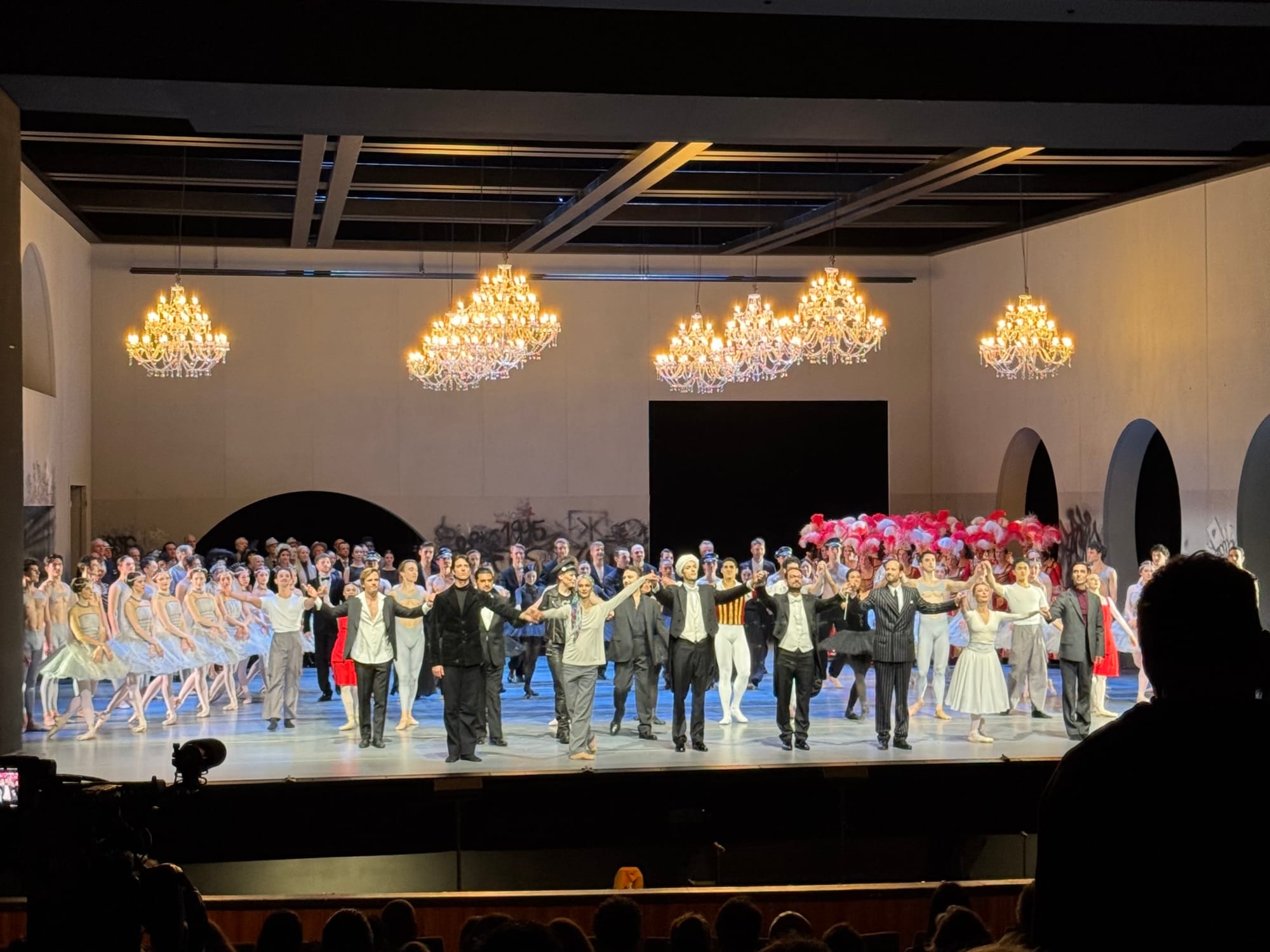
The production spans two acts and something in the order of 140 participants—dancers, extras, actors, opera soloists, non-professional bodies hired for their presence. The auction audience is populated by older figures, all of them former dancers from Berlin's opera world: people now in their sixties and seventies who once moved through these same spaces professionally. Watching them populate the re-creation of a world they once inhabited is moving.
What It Sounds Like, What It Looks Like
Ilya Demutsky's score does something clever and gorgeous. Rather than operating as pure contemporary composition—which it is—it behaves like a guided tour through the ballet repertoire that defined Nureyev's life. Swan Lake, Giselle, La Bayadère, Don Quixote: the melodies surface, half-submerged, within the score, recognizable and then released, the way a smell will summon a place and then recede. For the second act's grand gala—in which Nureyev's career as choreographer and stager of the classical repertoire is relived, sometimes reverently and sometimes in full fury—the effect becomes almost hallucinatory. You are watching a life being played back, with its own soundtrack bleeding through the walls.
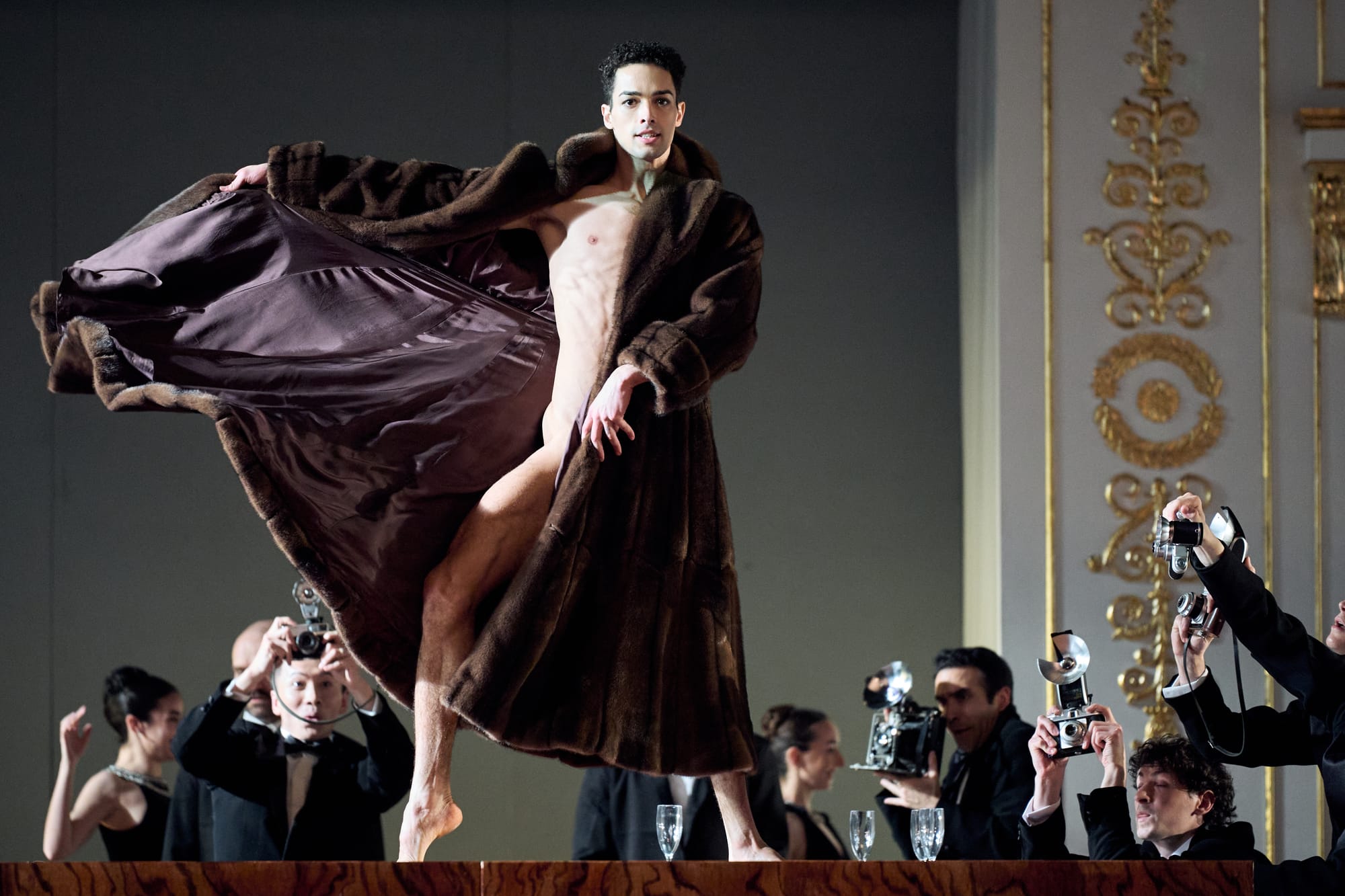
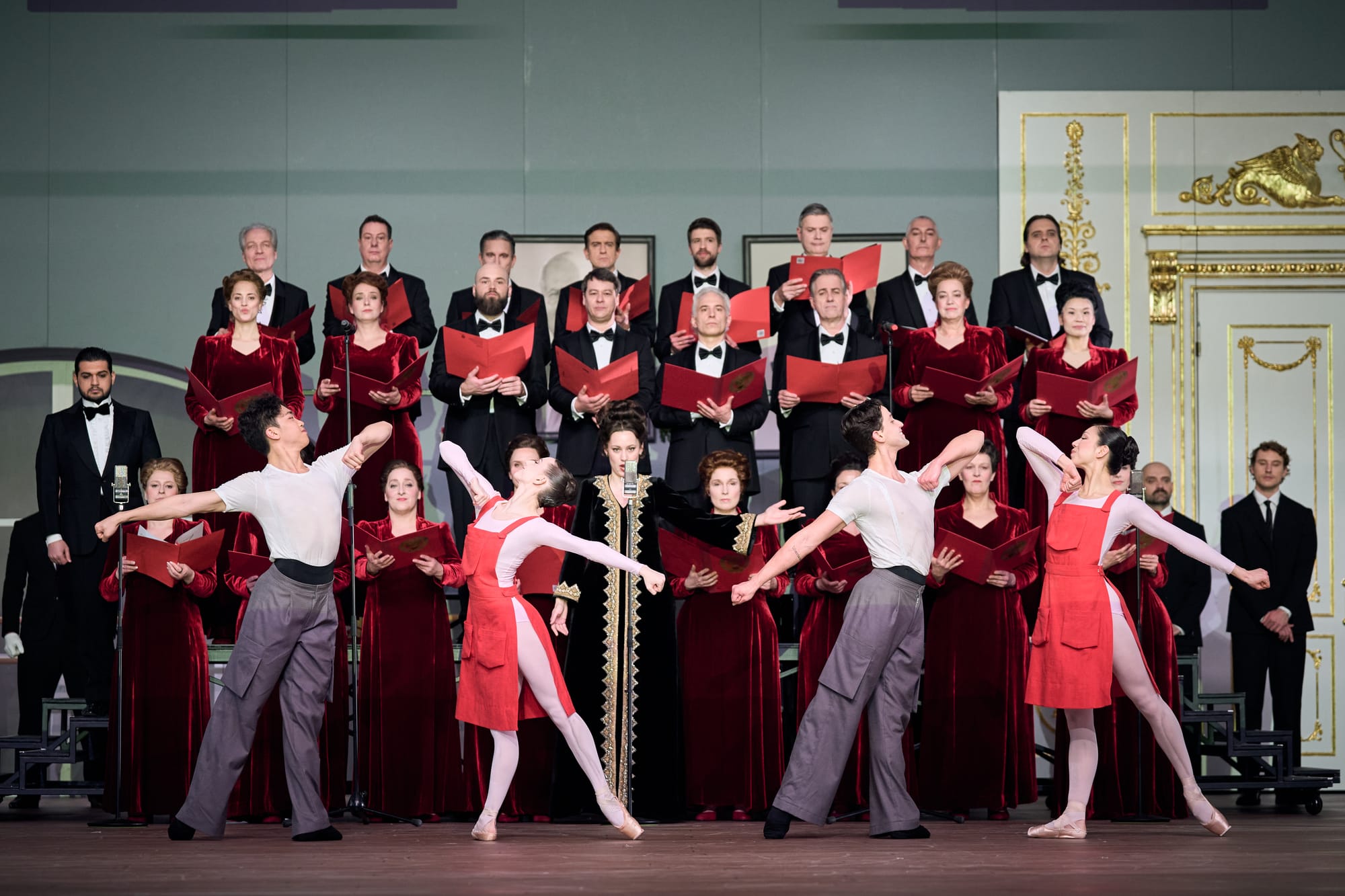
This is, without apology, a beautiful production. The stage is visually overwhelming in the best sense: the auction hall with its baroque doors and period fittings; the sweeping transformation into the Vaganova studio; the gala's layered opulence; and then the Baroque interlude—choir, sun-king costumes, a sequence that exists somewhere between homage and delirium. There are buff men in leather; there are drag queens in 1970s Paris. There is full frontal nudity, specifically a sequence centered on a recreation of Richard Avedon's famous 1961 photographs of Nureyev in New York. And threading through all of it, a woman in white—tiara, bouquet of lilies, present at the edges of every grief the production touches.
In the original Bolshoi production, this figure was played by a longtime member of the Bolshoi's staff—someone who had reportedly known Nureyev when he danced there, and whose identity the Moscow audience apparently knew. What that knowledge evoked in them is not hard to imagine, and whether a comparable substitution was found in Berlin, I cannot say.
The Soviet choir scene deserves its own mention. It is, by any measure, the production's most politically uncomfortable passage. A mass ensemble in proletarian costume performs a patriotic number about the glory of the Soviet state—while, simultaneously, the narrator reads at speed the real text of Nureyev's public denunciation, the kind of official proclamation that Soviet courts issued in these cases and that continues to haunt Russian judicial proceedings today. Russian friends in the audience said they knew what was coming the moment the metal crowd-control barriers were wheeled onto the stage.
A verse from the song itself—Seine Heimat sucht man sich nicht aus—sits alongside one of the production's correspondence passages that cuts even closer: you didn't love the system, but you loved your Russia. That sentiment, addressed to a man who had fled, speaks directly to a question the production refuses to resolve and probably shouldn't: what do you owe a country that doesn't want you? For the Russian diaspora now in Western Europe—for the people in that audience who had left by choice or necessity since 2022—this is not a historical question.
The Problem of the Treasure
Nureyev was made in 2017, premiering in Moscow under conditions of real creative risk—a gay director, a queer subject, an institution that nearly lost its nerve at the last moment, a first night attended by the entire Moscow cultural establishment while Serebrennikov was already under house arrest. In that context, it was an act of courage and a provocation. It meant something specific, with stakes attached.
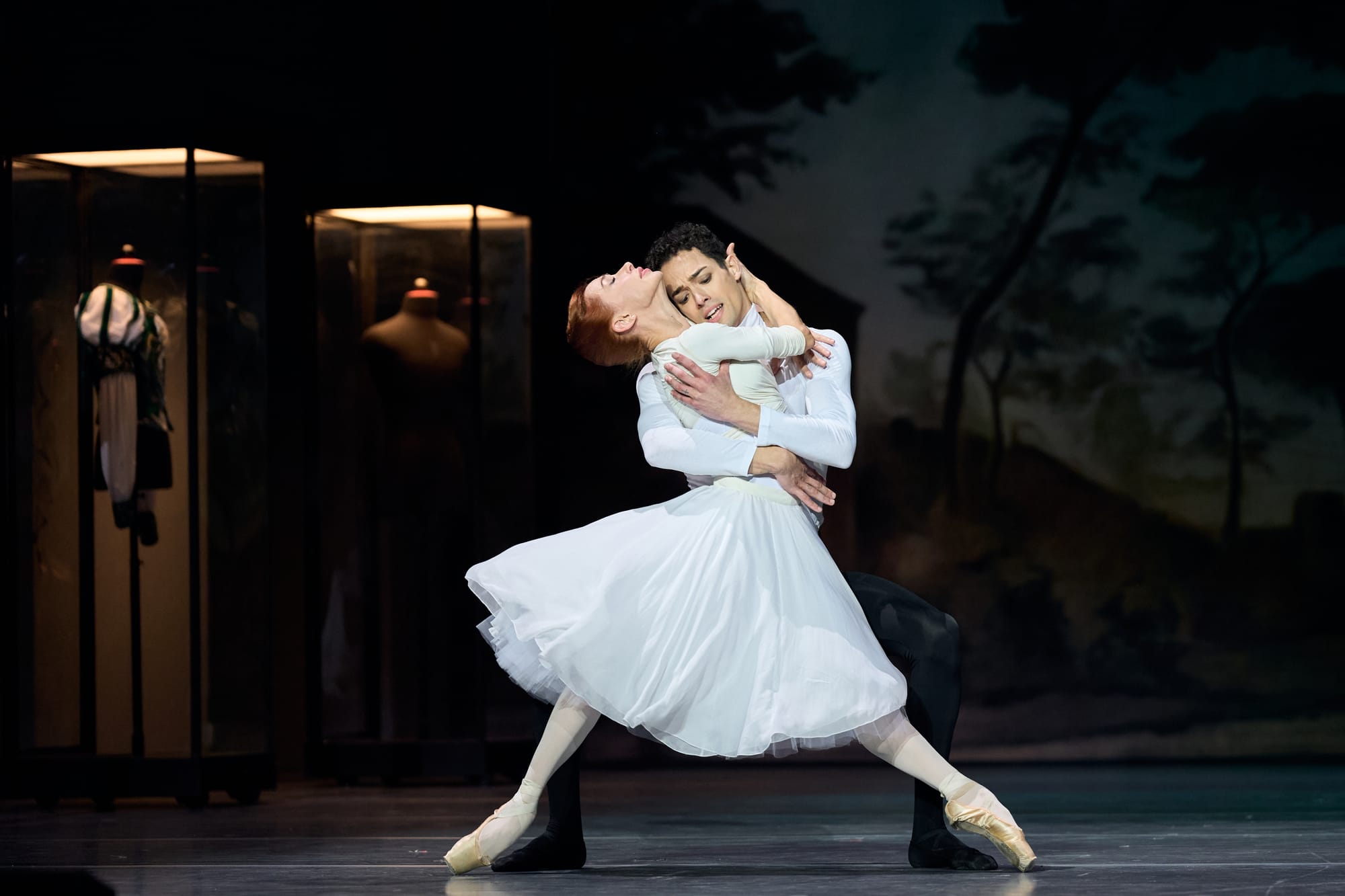
And yet: Berlin in 2026 is not Moscow in 2017. I say this not to diminish the production but to clarify the question it raises, which is fundamentally about what it means to bring art across time and context. Berlin is a city that has, by now, seen a great deal. Nudity is not shocking here. Queerness is not radical here—or rather, it shouldn't be, and on a good night, isn't. The production's gay content, which is real and present and at moments genuinely moving (a pas de deux between Nureyev and Bruhn closes with a kiss, something that was not yet part of the general rehearsal and arrived only at the premiere), is also, from a 2026 Berlin perspective, somewhat restrained. A scene set in the queer nightlife of post-defection Paris left me genuinely uncertain what I was looking at—drag, trans femininity, something else entirely—and unsure whether that uncertainty was the point. The fact that Nureyev died of AIDS is never explicitly stated. For a piece made in 2017 Russia, these choices are understandable and perhaps necessary. For a piece being presented in Berlin now, they read as blank space. I found myself wanting more—which is its own kind of compliment, but also a kind of frustration.
I don't raise this as a criticism of the decision to bring the production here. Productions travel across time and space all the time. And this production's creation context is not background color—it is structural to the thing itself. The specter of what it cost to make Nureyev in 2017, of what it costs to have banned it in 2023, of what it means that it now lives in Berlin while its director lives in exile—these haunt the production more effectively than any staging choice.
What Lingers
The question remains, even so: stripped of all that, is this formally radical? Is it as daring as what goes up on Berlin's stages routinely? Is its choreography truly remarkable? Is its queerness or its political charge new to a European audience that has spent a decade watching Serebrennikov develop his language on major stages across the continent?
Perhaps the more honest answer is that the production doesn't need to be. David Soarez, who dances Nureyev, was in the original Bolshoi cast in 2017—in the corps, not yet the center. He left Russia when the full invasion began in 2022, came to Berlin, and is now dancing the lead in the same production, a decade on, from a different position within it. It is one more version of the story this production keeps telling—of people displaced, of things banned and then resurrected elsewhere, of a city that has become, for better or worse, the place where that happens.
The production will run again, and again after that, in Berlin and likely beyond—other houses are already circling. Nureyev is, it turns out, still in motion, as perhaps it always was: a life that couldn't be contained by one country, one stage, one decade. What it ultimately asks is whether context is transferable—whether a work made under pressure retains its charge when transplanted, or whether it becomes, in the softer air of a liberal city, simply beautiful. I don't have a clean answer. But I was moved, more than once, and the questions I left with felt more alive than the ones I arrived with. For a nearly decade-old production, staged in a city that has seen almost everything, that is quite something.

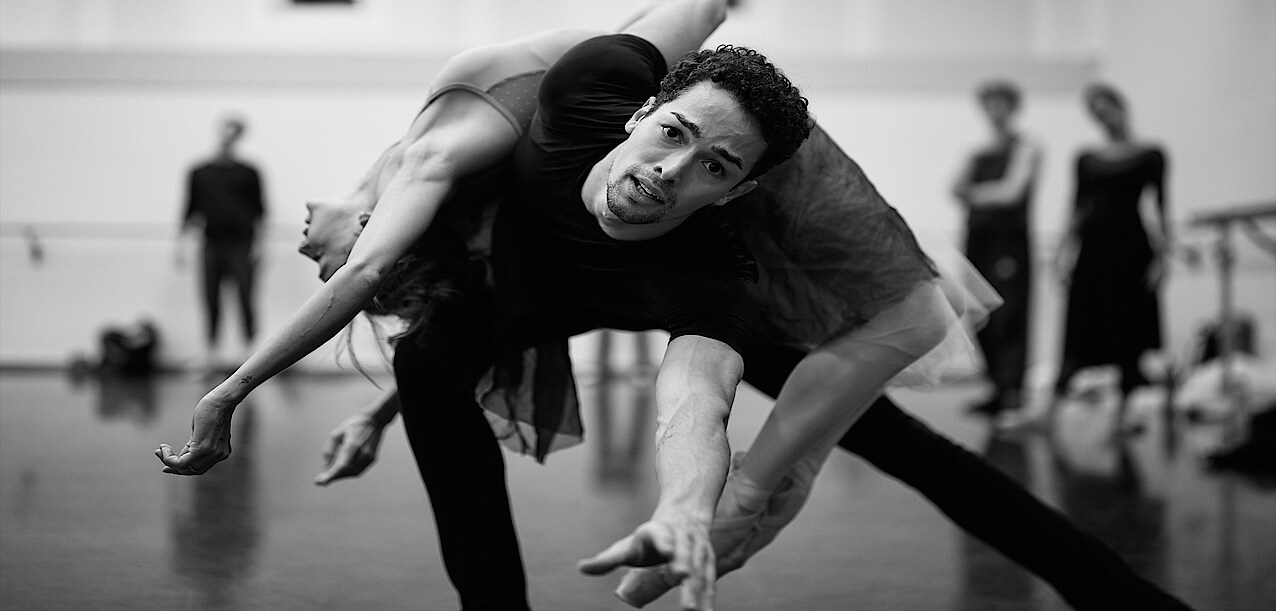
Cast - General Rehearsal and Premiere
Choreography Yuri Possokhov
Staging and libretto Kirill Serebrennikov
Music Ilya Demutsky
Set Design Kirill Serebrennikov
Bühnenbild-Assistenz Olga Pavluk
Costumes Elena Zaytseva
Video Ilya Shagalov
Lighting Design Daniil Moskovich
Einstudierung (Tanz) Dana Genshaft / Tiit Helimets / Yannick Sempey
Einstudierung (Regie) Evgeny Kulagin / Ivan Estegneev
Musical Direction Dominic Limburg
Orchester der Deutschen Oper Berlin / Vocalconsort Berlin
Nureyev David Soares
The Student Anthony Tette
The Diva Polina Semionova
The Ballerina Marina Duarte
Erik Martin ten Kortenaar
Margot Iana Salenko
Actor Odin Lund Biron
Mezzosoprano Aleksandra Meteleva
Baritone Navasard Hakobyan
Countertenor Iwan Borodulin
Harp Alexander Boldachev